Author: Alex Doenau

Alex Doenau is an Australian film and book critic based in Sydney. His interests include video games, Pokémon, and amiibos as far as the horizon.

Wall-e: Popcorn Taxi

What you have to understand is that the idea of seeing a Pixar movie and then having a director Q&A afterwards – along with legendary sound designer Ben Burtt – is one of my ideas of Heaven. If I thought about it, Heaven would probably be an interconnecting series of cinema screens.
Wall-e, screening on August 25th, with special guests Andrew Stanton and Ben Burtt, reduced the pain of the three month release delay by a large margin. I just feel sorry for the poor saps who have to wait for the September 18 wide release.

Wall-e is a special movie: almost no dialogue, a pervading sense of duty in the face of loneliness, and characters who actually surprise us. It’s like I Am Legend if that movie had remained consistently good and was predominantly a love story. It’s also nice to know that the theme of “last robot on Earth” was a Science-Fiction conceit, rather than a damning indictment of humanity’s commitment to anti-environmentalism. This is not a movie about nature, but about human nature – and also the ways that it manifests in the limited AI of cute, beat up looking robots.

Not really spoilers within, but definite discussion of the “flavours of Wall-e“.

A Vague Treatise on FPS Points of Difference


This image of Rapture is not going to be sourced, for the protection of my mental health.

As I wandered the aisles of a game store yesterday, looking as always for rare or obscure games (to be played, of course, only when any relevance they once held has eroded into the mists of time), I was thinking, as you do, about the nature of the FPS and story driven gameplay. A lot of the games nowadays are FPS, and I was thinking that it must be hard to mess one up, at least on a very basic level: while level design, enemy design and AI, weapon balance are, of course, vital, we can accept that FPS are all basically the same – point and shoot games of varying elaborateness.

The thing is that all of those things that I listed above are what separates each FPS from the others: levels, enemies and weapons are all dependent on theme. If you don’t give an eff about the place that you’re running and gunning through, then why are you going to run and gun? Would Portal have become the hit it was, and apparently the only thing in the universe that channers don’t hate (excepting Ron Paul and green Guy Fawkes masks), were it not for GlaDOS? I posit that it would not. It’s a short game, with a story that is told in a relatively subtle way, with its very sterility a key to its seedy underbelly. Portal is not a great example because it has fundamentally different game play, because it’s more of a First Person Puzzler than it is a First Person Shooter.

Condemned: Criminal Origins

What do you mean, it’s the wrong Condemned?

It’s a sad fact that I have a natural affinity for cheap games. When I saw the PC version of Condemned sitting on a shelf, mocking me with its $5 pricetag, I couldn’t help but snap it up. I think that, falling victim to the siren song of “cheap” games, I may have spent three or four hundred dollars on video games across multiple platforms that week. Am I ever going to play them? I’ve got stuff I bought in 2004 that’s never been out of its packaging, so the jury is out!

The amazing thing about Condemned is that I bought it about seven weeks ago and have already completed it. I judge it: worth the $5 I pay for it. It has the distinction of being the first FPS that I’ve managed to complete with a mouse and keyboard set up. I have the original Half-Life on this computer (not Source) and it’s somehow impossible to play that way. At least now I have learned that it’s a valid control scheme for a game to take on.

As to the game itself? Basically, FBI Agent Ethan “Officer Matt Parkman” Thomas has to investigate a bunch of serial killers – but, mid investigation, some of his comrades get killed with his gun and he’s on the lam! Somehow his lab access isn’t cut off, though, so he teams up with Lab Tech Rosa (Klebb), digitally transfers fingerprints, blood and general DNA to her with technology, and busts all of his cold cases wide open.

There’s not that much to say about it, but it tells a fairly compelling story, has okay melee combat and is entirely too dark. I would like to play an FPS that features its share of brightly lit areas and has more colours in its pallet than brown, grey and black. When I say this, it does not mean that I want to play Perfect Dark Zero, because nothing could be further from the truth: no one in the history of humanity has ever wanted to play that game. Those of us who have would likely testify to having been caught up in a lost wave of brand loyalty to Rareware.

There are reasons to play Condemned: it made me wonder why anyone would play any given FPS over another, and that is something that I will tackle later. All you need to know is that I’m shallow enough that the price tag of a game can render it much better than it would have been at a higher price point – which makes you wonder how people who never pay for games can sleep at night, knowing full well that there are serial killers to be stopped and weird pseudo-mystical BS to tamper with their minds.

Wanted

“Imagine one thousand!”

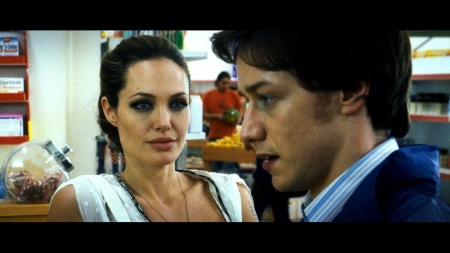
Put Angelina Jolie’s stunt arse in something, and you will make hundreds of millions of dollars. Place the gentle Scotsman James McAvoy in a movie as a pathetic and then ultra disgruntled American that you’re supposed to cheer and … I can’t speak for everyone else, but I know I was disturbed by the message of this piece: ultra macho posturing, and a meditation on what it means to be a man.
For those wondering what it means to be a man in today’s workaday world, it’s about bottling your rage and then letting it out in huge destructive bursts; it’s about not being a “pussy” and about “growing a pair”.
And they wonder why I despair of modern masculinity.

Some spoilers for this Godforsaken Hell hole!

Pineapple Express

“Don’t need no credit card to ride this train.”

Easily the best thing about Pineapple Express is that the title song is written and performed by Huey Lewis and the News. Now, it’s no “The Power of Love” but it’s pretty good. The rest of the movie? Not so good. That’s not to say that it’s not without its moments, and I have no idea if it would be a better movie for a stoner to enjoy. I’ve never stoned, and I’m guessing that I never will – it just doesn’t interest me in the slightest. This is a stoner action movie from Seth Rogen and Evan Goldberg, the same team who wrote Superbad. Among the many good aspects of that film, one that particularly stood out was that it had no reference to marijuana at all – which had always been an important aspect of Rogen’s characters in other Apatow productions.
Pineapple Express is pretty much all of the violence and marijuana that wasn’t in Superbad, although it retains some of the homoeroticism (and adds to it bizarrely: “I want you inside me, Holmes.”), the theme of BFFF, and also involves a man saving another man by carrying him away from a scene of carnage. It basically turns into a stoner version of Hot Fuzz, deliberately styled after bad seventies movies, and isn’t particularly good in itself.

That said, it’s probably going to become some sort of huge cult movie, but not one for me.

Dale (Rogen) is a Process Server who spends his days disguising himself, serving subpoenas, and getting high. He goes to visit his dealer, Saul (James Franco, infinitely better here than in Spider-Man 3), and gets Pineapple Express, a weed so rare that it’s almost a shame to smoke it: “like killing a unicorn”. Joint in hand, Dale goes to deliver a subpoena only to witness a murder committed by Gary Cole and Lady Cop Rosie Perez – problem is Gary Cole recognises the taste of Pineapple Express and track its use down to Saul and, by connection, Dale – who go on the run and … uh, stone, and steal a car, and have a guy shot several times, and general violence ensues.

Pineapple Express has quite a few funny things in it but it’s really an awkward and unwieldy beast. I think a lot of this is quite deliberate, particularly the scenes between Cole and Perez – set in a very seventies style mansion, no less – but it’s not as fun as it should be when it tries to tackle genre (“Asian Commandoes! Check these explosions out!”) and the heart seems much more faked than it ever was in Superbad. The handling of Dale’s relationship with an eighteen year old is pretty good and realistic, and Cole’s henchmen are pretty funny as well … it’s just the movie doesn’t really click: it’s a collection of scenes that service a story but it’s not very easy to care about any of it. It’s certainly better than Drillbit Taylor, but frankly not a lot isn’t.

In many ways, it’s good that Pineapple Express got made. It’s a little smarter than other stoner fare like Tenacious D in The Pick of Destiny, and it hopefully means that Seth Rogen has got a very important message out to the world: he likes weed, he doesn’t care who knows it – and, dangit, now he can move onto something else.

The Ancient Art of Raymonding

Raymond verb:
To completely miss the point in an hilarious or embarrassing way.

Example of Raymonding, during the credits of The Dark Knight : “Why was that movie dedicated to Heath Ledger? … Was he originally going to play Batman or something?
… Heath Ledger played The Joker!?”

My friend Raymond is the world’s chief committer of the act of Raymonding, but I am not above admitting that I have Raymonded a movie or two in my time. My most recent example is The Counterfeiters, which won Best Foreign Movie at the Academy Awards this year.

The Counterfeiters is the story of a group of Jewish prisoners of war in Nazi Germany who are forced to counterfeit various currencies for the war effort. The movie has a master counterfeiter serving as the protagonist, and he has an antagonist in the film in the form of a man who was a vocal protestor in his days on the outside – and who is trying to sabotage the operation from the inside. I found myself thinking during the movie that this guy was just endangering the lives of the other prisoners with his sabotage efforts, and I got very frustrated with him. My explicit thought was “Just counterfeit the damned bills, they’re going to lose anyway.”

You may have noticed the flaws in my argument, these being: the prisoners did not know that Germany was going to lose the war; that, in sabotaging the progress of the counterfeit operation, they actually contributed to the weakening of the Nazi war effort, which may have been part of the difference between victory and defeat.

I did not vocalise these thoughts, so there was no one around to keep me in check. It was not until halfway through the following day that I realised that I was an idiot. At that point, I came to the conclusion that not even I can be protected from Raymonding.

Post-script: I don’t think that I spoiled The Counterfeiters by telling you that Germany suffered defeat in World War II. If you want to correct me, though … I’ll actually be pretty worried, in fact.

Happy-Go-Lucky

We only have to spend two hours with her.

When I saw a trailer for Happy-Go-Lucky many moons ago (I believe it was when I saw The Counterfeiters, which I would recommend to all and sundry), it appeared to me a movie about an insufferably cheerful woman. When I finally went and saw it, I was proven 100% correct! I mean, I went into it expecting to see an insufferably cheerful woman, that’s what I got, and that’s not what I’m complaining about. This is a weird little film, and I believe it’s “film by committee” – but the committee is that of the director and actors, rather than any studio. A strange experience to be sure.

The Dark Knight: Epilogue

I saw The Dark Knight tonight. It came out a day earlier than advertised, yet all of the sessions were still sold out. At the end of the experience, I had a conversation with Raymond. You must keep in mind that, upon watching Blade Runner with me, Raymond asked me what a replicant was.

Credits: In loving memory of our friend Heath Ledger.

Raymond: Why is it in memory of Heath Ledger?
Alex: Because he died six months ago. Where have you been?
Raymond: I know that he died, but why is it in his memory? Was he originally going to play Batman or something?
Alex: Heath Ledger played the Joker.
Raymond: Heath Ledger played the Joker?!
Alex: What the fuck!?
Raymond: I couldn’t tell! So they made that movie before he died?
Alex: I have no words.

The movie was insanely tense. You should watch it!

Mass Effect in Brief

My initial impressions of Mass Effect‘s overall package:

Prologue planet: This isn’t a war, it’s a moider.
Citadel incursion: Politics, eh? You’d better give me some of those.
Planet the first: Save the Diva Plavalaguna!
Planet the second: Protect the fidgety colonists from themselves!
Planet the third: Deal with red tape, then slaughter … Zerg? … yeah, okay.
Planet the fourth: WE WILL TAKE THEM ON THE BEACHES

Cue POLITICS and SEX

Planet the Fifth: ONCE MORE UNTO THE BREACH

Epilogue!

Council: You are charged with having saved the galaxy and rendering the threat to our continued existence moot. How do you plead?
Shepard: Awesome.

Shepard dons sunglasses and walks away as explosions go off behind her.

Roll credits.

Yeah; it was worth it in the end.

Hancock

“That’s ’cause I’ve been drinking, bitch!”

Hancock is the new critical punching bag of cinema. Except for in Australia, where for some reason the Sydney Morning Herald proposed the idea that a black superhero is clearly a metaphor for Barack Obama.

The thing about Hancock is that it’s not a godawful movie. It has some good ideas. The problem is that a lot of the film, technically, is executed in a “we want to make you sick without even having Cloverfield to justify it” fashion. Seriously, the camera cannot stop moving, even for ostensibly still shots. It’s like you’re watching the movie in a storm on the high seas, and Will Smith needs to drink to steady himself.

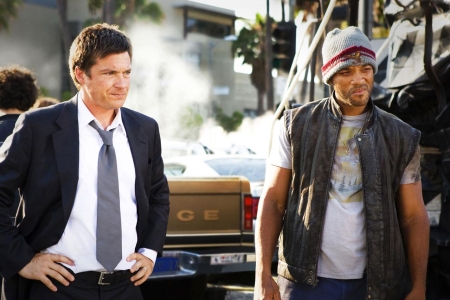
Hancock (Will Smith) is a “super hero”, who lives the life of a derelict and causes more damage than he prevents. The public generally hates him but, after not-quite-successful PR guy Ray (Jason Bateman) has his life saved by Hancock, they decide to team up to improve his public image. Problem is that Ray’s wife, Mary (Charlize Theron) simply doesn’t like the guy. There’s some other stuff besides about hero mythology that’s pretty good, too.

This isn’t “finally” a movie about a superhero whose actions have consequences – it’s about a superhero who just does whatever the Hell he feels like. That’s entirely different to a movie in which a superhero does whatever it takes to defeat evil and the story carefully ignores the inevitable fall out of his actions (although I really don’t know what movies Roger Ebert has been watching – what superhero movie in recent times hasn’t shown a superhero desperately trying to stop a speeding train while also preventing the death of a family of ducks that stands square in the right place to set a speeding train aside?). Hancock can take off and land without destroying the pavement all around him, but he can’t be bothered to do so. He could probably be kind and polite to the general citizenry, but he doesn’t feel the need.

Which is where the film’s strength does come in: beyond all of the “I’m gonna stick your head up his ass” bravado – although it’s not really bravado considering that he follows through with the threat – he’s a nice dude with a broken trust in himself and in humanity. When he’s rude, he’s funny, but when he reveals his damaged side it’s kind of warm and fuzzy. Jason Bateman is pretty good, if a little samey, but Smith and Charlize Theron carry the movie to its mostly logical, if a little contrived, conclusion. You’d think this sort of movie wouldn’t need, or wouldn’t use, a rich and illustrious backstory, but it does and it does it well. The problem with the nature of this genre is that they need final conflicts and amped up stakes, and I probably could have done without them – but by this point I’d almost completely forgotten about how shoddy the production values had been because the rest of it had turned out pretty well.

The beauty and the curse of Hancock is that it is set up in a way that a sequel would be utterly, utterly redundant. The problem is that if it makes as much money as they want it to, a sequel is inevitable.

PS. Obama ’08. Do it.