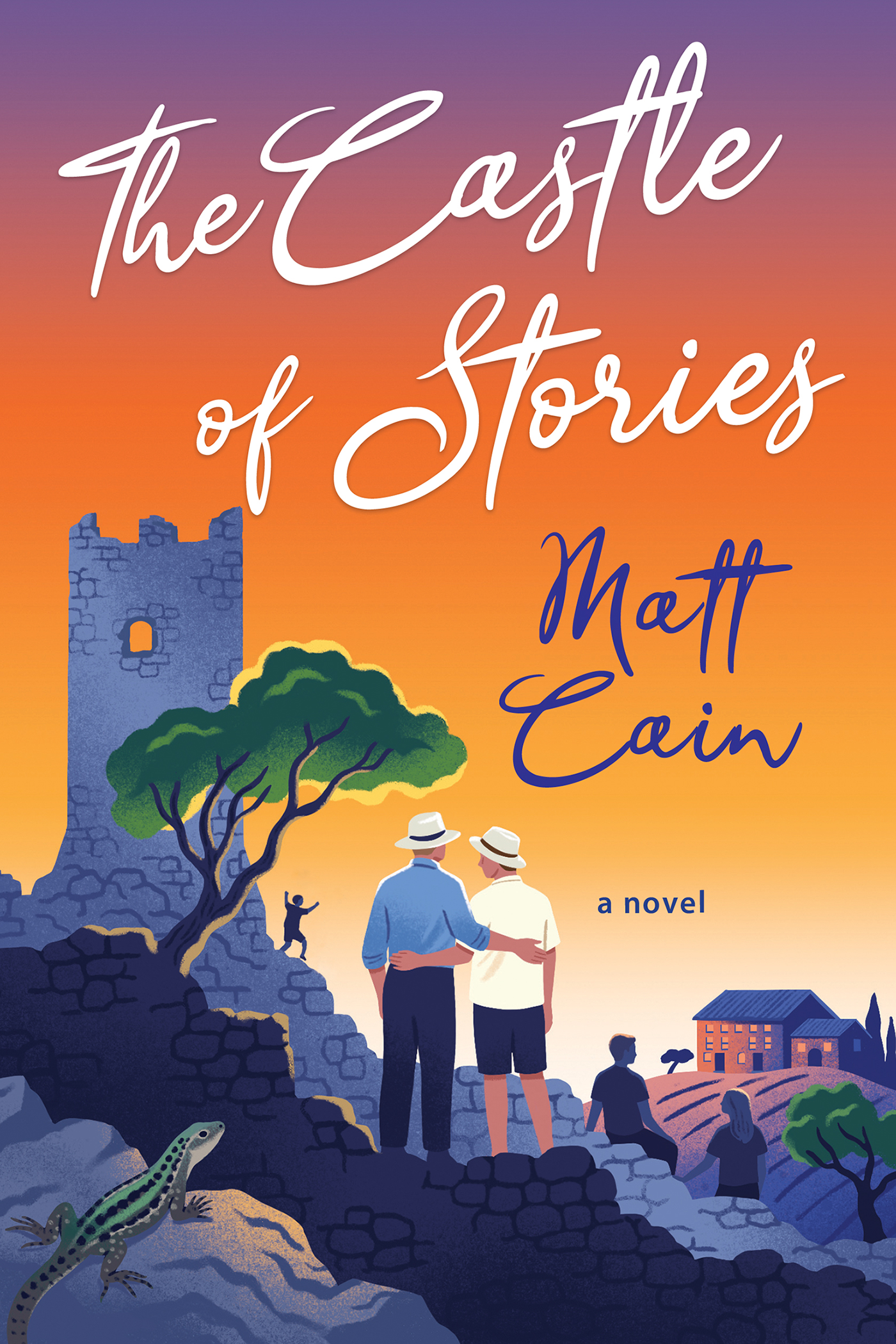
England has, as history has borne out, taken for granted its access to Europe. There’s probably a baseless claim to me made that Brexit occurred solely to present homosexual men from traveling to the Italian countryside to “go find [them]self or whatever”. Matthew Cain’s awfully named The Castle of Stories is about what happens when a man approaching middle-age finds himself propertied, saddled with three children and in love with a man who never stands up for him.
Upon learning that the great uncle that he never knew he had has died and left him an estate in Italy, Adam Webb decides to spend six weeks of summer renovating it for both use and renting it out. When Adam’s boyfriend Theo’s plan for his three children to visit for one week turns into the entire break, Adam finds himself constantly beset by ingratitude, open rudeness, and mosquitos.
The Castle of Stories is a book that offers few surprises except for how much a man with low self-esteem and abandonment issues can tolerate before he snaps completely. This is a book of only two acts, rather than three, and they’re delineated by how poorly Adam is treated. People who don’t have the contractual obligation to be the narrator of a book would likely remove either themselves or the offenders from the scenario where they’re facing consistent abuse. For that reason, half of The Castle of Stories can be construed as deeply unpleasant, and often Adam offers phantom dialogue that he should have offered to the people who are either attacking him or failing to defend him.
When the characters realise that maybe Adam deserves a break and that it’s not his fault that the kids’ father had been living a closeted life for decades, The Castle of Stories turns. The reader will no longer want to everyone to suffer for their crimes, but that means that the rest of the novel has essentially no conflict because Cain forgot to replace the backbiting with anything more serious than building standards maybe not being up to code.
This is marginally uncharitable because the back end does go into Adam’s extreme fear of abandonment, the largely unexamined matter of his mother’s death and subsequent distant relationship with his father, and the mystery of who great-uncle Wilfred is. Wilfred’s identity is unsurprising to anyone even marginally smarter than Adam, who often refuses to put two and two together. The maddening construction of this book is that Adam frequently finds letters and artefacts of the past and sets them aside to read “later”, and then keeps setting them aside so that Cain can drop them into narrative as carefully detonated bombs. These documents never require the hours that are set aside to consume them, so it does not make much sense to drip feed them to us. The incurious nature of this protagonist is more likely to kill him than a battlement falling off his castle and crushing him to death.
Harsh though this may sound, The Castle of Stories legitimately rallies into something pleasant. It’s a long hike to get there, and it really reads like a non-threatening gay book for right-on straight people to read to feel better about themselves. Cain goes far enough to provide an actual spectrum of the rainbow in Adam’s friend group, although Gloria’s relationship to gender is more complex than an English author in his country’s current dark age is willing to explore, and the experience is overall more sunny than not.
The Castle of Stories is not going to be most peoples’ idea of essential reading, but there is an audience for this sort of novel. It’s the first book from Cain and his husband Harry Glasstone’s publishing company Pansy, and potentially the first of many. LGBTQ+ people deserve all kinds, and while this might not be the best it can still be encouraged.
A review copy was provided by Pansy.