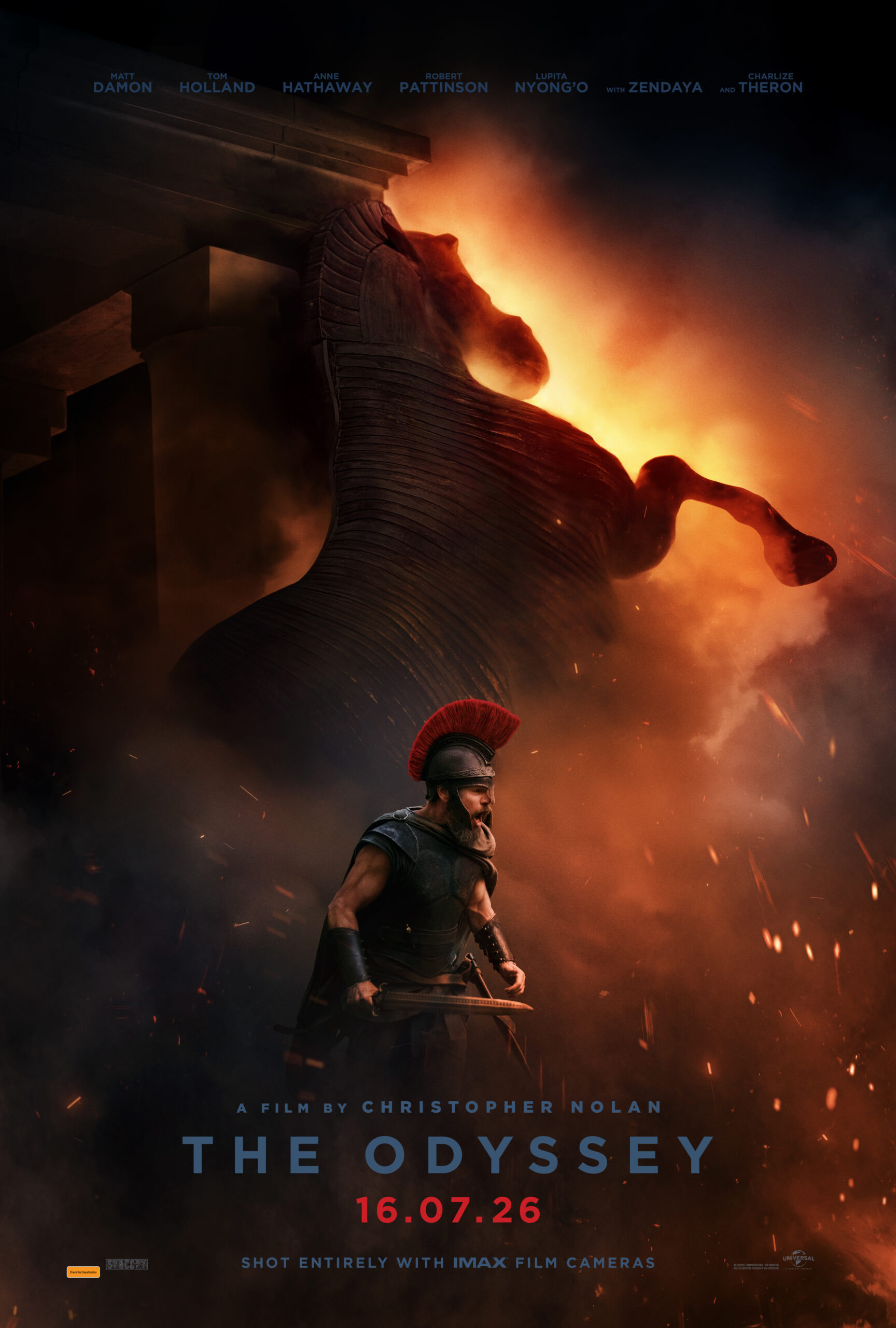
Christopher Nolan (Oppenheimer) knows big. For the last 18 years, he has used IMAX cameras for at least part of every film that he has made. With The Odyssey, he follows this theory to its most natural —and maximal — conclusion: what if he made the entire film with IMAX cameras? With them only being able to hold four minutes of film at a time, The Odyssey is composed of at least 43 takes (don’t try the maths on this), and all of them carry an extreme weight. The size of the film translates not to epic sweep, but a close held intimacy. There are wide shots of boats on oceans, there are storms and battles, but more than that there are faces.
In a “time of apparent magic”, ten years after the end of the Trojan War, and twenty years after he left Ithaca, Odysseus (Matt Damon, The Rip) is still trying to get home to his wife Penelope (Anne Hathaway, The Devil Wears Prada 2) and Telemachus, the son he left as a child (Tom Holland, TV’s The Crowded Room). As Odysseus faces everything that the unseen gods throw at him, Penelope must fight off the multiple suitors who wish to marry her and ascend the throne, and Telemachus attempts to learn more of his father without compromising Zeus’s law of hospitality.
Like the works of Shakespeare, The Odyssey has had an undeniable influence on the English language. This movie lives up to its name because it is the very story that gave the word Odyssey its meaning; similarly, Telemachus’ mentor being named Mentor is not an act of a bankrupt imagination but the wellspring of an entire role. Despite not being a slavish adaptation of the twelve thousand lines of the poem, Nolan respects its structure, albeit not in a linear fashion: if there is one thing that The Odyssey is, it’s episodic (another word derived from Greek). You could be forgiven for thinking that this is the story of Odysseus making land on an island, immediately realising that it’s a terrible idea to be there, and evacuating with mass casualties incurred on the way. That’s just kind of how it was.
Some of these episodes are more significant than others, and allow Nolan to exercise a rarely seen penchant for hallucinatory horrors. Odysseus’ encounter with Polyphemus is rendered in a suitably Goya-esque fashion, and the island of Circe (Samantha Morton, Anemone) is enough to give anyone pause. The Odyssey flexes a muscle that Nolan traditionally has only used in conjunction with Cillian Murphy, and it serves him well here. This is possibly his least grounded work, and it gives him the chance to be more than a little freaky — and, for once, unafraid to stage his horrors in the stark light of day.
Nolan’s not above an act of whimsy, and is not afraid to remind the viewer that they are watching a film. Odysseus’ bow literally sets the tone of the movie, leading and shaping Ludwig Goransson’s score (Star Wars: The Mandalorian & Grogu). When Odysseus’ sailors’ ears are blocked by wax to ward off the sirens’ song, so too are we muted to their majesty in one of the film’s more affecting moments — and The Odyssey is far from short of affecting moments.
While Damon has to carry a lot of the movie with a constantly diminishing set of companions, including an increasingly hard done by Himesh Patel (Enola Holmes 3) as Eurylochus, he has more range than anger and fear. There’s a good deal of physical transformation involved in the role, as Damon portrays the passage of years, but more than that he bears the weight of expectation, regret, and lost time. These are wells that Nolan has drawn from over the decades, but this is a man constantly honing his craft and in Damon he has found a near perfect vessel. As Telemachus, Holland is frequently surprisingly affecting, at turns sorrowful and petulant and infuriated. He shares a moment with Jon Bernthal’s Menelaus (TV’s The Bear) that almost sells the entire film on its strength alone. Hathaway is the film’s engine, largely obscured until she can’t hold it back any more, but special mention must be made of Robert Pattinson (The Drama) who once more thrives as the absolute weirdo creep Antinous — a part he was born to play.
Despite the Greeks inventing the deus ex machina, there are no gods to be seen here. They are felt both in their presence and absence, and Nolan has not at all made The Odyssey into a realistic experience. It is visceral, lusciously shot by Hoyte van Hoytema (Oppenheimer), and very deliberately edited by Jennifer Lame (Oppenheimer). It earns each of its 172 minutes, through the toil of a man who feels like he’s in control of every element.
The Odyssey, despite its near three thousand year vintage, feels immediate. Obviously Nolan has elided much of the story, and changed things for his own purposes, but ancient tales evolve in the telling and reveal as much about the teller as they do about the ancient history they describe. This movie is many things: it’s about a man who really wants to get home (but also kind of doesn’t), a woman who resents her station, and a son who really doesn’t want a step-father. It’s the story of desperately trying to fight the fate that has been handed down to you, and of living up to the impossible expectations of a world that both doesn’t care about you and is desperate to see you fail. The Odyssey is the horizon that Christopher Nolan is striving towards, and it is so lovingly composed, so entirely complete in and of itself, that you can’t help but be willing to sail wherever it wants to bear you.
The Odyssey opened in Australian cinemas on July 16, 2026.
Directed by: Christopher Nolan
Starring: Matt Damon, Tom Holland, Anne Hathaway, Robert Pattinson, Lupita Nyong’o, Samantha Morton, Zendaya, Charlize Theron