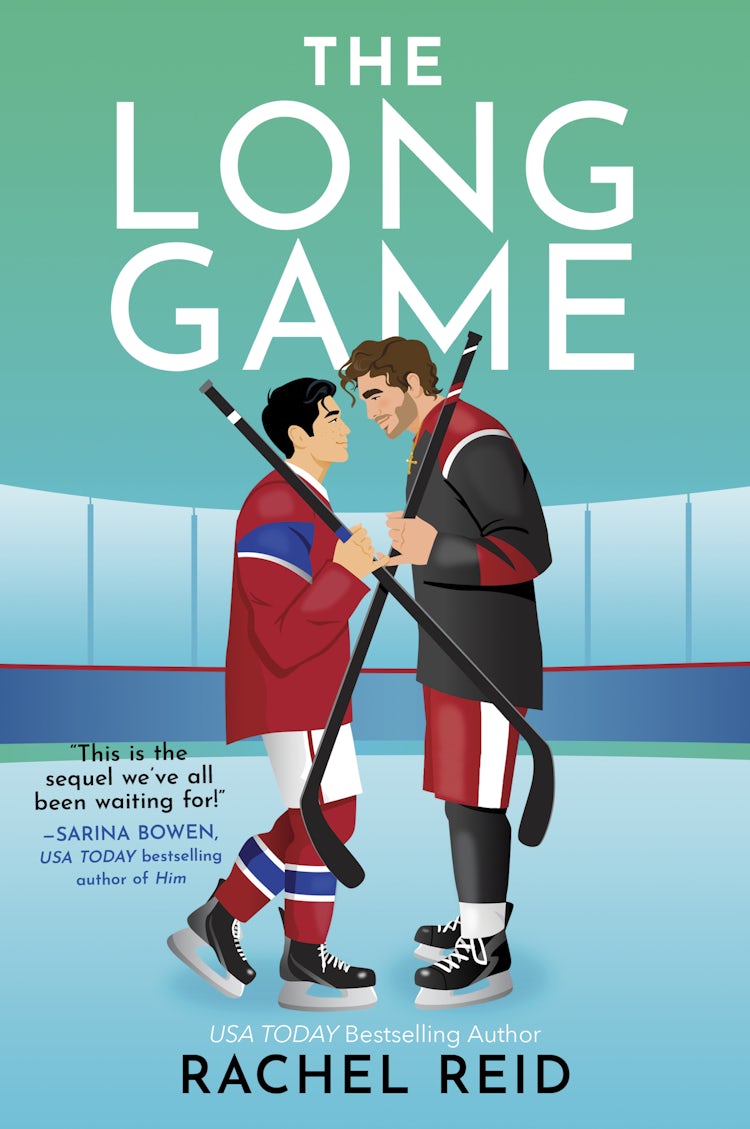
It’s kind of amazing that, just as Rachel Reid finally developed a Grand Unified Theory of Gay and Bisexual Hockey (GUTGABH), that she’s just about thrown in the towel. Originally there was going to be a book about the very minor character (and Spider-Man drawer) Luca Haas, and then she decided that it sucked and shelved it, calling it quits here, with The Long Game. Things changed (possibly the breakout reception of the Heated Rivalry TV show? We can never know for certain) and Reid decided to dust off her old pals Ilya and Shane for a final hurrah in Unrivalled, delayed until 2027 but still coming.
Which is fortunate, because in The Long Game she’s really cooking with the universe that she crafted over the five books leading up to this point. Where Tough Guy used the sex scenes to inform the characters in a way that showed growth and maturity on Reid’s part, in The Long Game we are shown how sex is used to paper over the cracks of a relationship in turmoil, two men who are still not able to fully communicate after more than eleven years falling back on the comfort of physicality. Reid has an ensemble across several teams and two countries, and she uses them.
Now, this is not a full career retrospective of Reid, as I have not yet read Time to Shine or The Shots you take, which fall outside of the Game Changer universe. We’re talking exclusively about the world in which Ilya Rozanov and Shane Hollander skate.
Three years after Shane and Ilya realised that they truly cared about one another, they still have no plans to come out or go public with their relationship. This is beginning to grate at Ilya, languishing in an underperforming team and isolated from every element of his old life, but things just keep getting better for Shane. As Ilya’s thoughts grow darker and Shane grows more oblivious to everything that Ilya has sacrificed for their relationship, one begins to wonder: should they call time?
Reid has to be given points for two things: at times, The Long Game is a massive downer. Ilya is depressed and his narrative reflects this. There’s a loneliness and injustice to the position that he finds himself in even if logically we know that he’s in a good place with the Centaurs. Shane runs roughshod over Ilya’s feelings without consideration in a fashion that can’t be entirely attributed to his autism (which is never named on the page, only in external communiqués from Reid). Reid makes Shane inconsiderate and unsympathetic to as high a degree as is allowed without being classified as character association; it’s a very delicate balance and Reid manages to strike it. These are people for whom a declaration of love and a rough orgasm has historically solved almost any problem, so why would it ever stop working?
A lot of The Long Game takes place concurrently with Role Model; scenes with Ilya and Troy Barrett are either repeated from a different angle or alluded to throughout. This is genius, in a way, because what would seem incredibly contrived from a dramatic standpoint at this point in the story is softened by the reader knowing that it already happened in the previous book and to expect it. The scene in question seemed more dramatic in Role Model, but the emotional honesty that it exposes in both Shane and Ilya is rewarding. It’s also worth noting that Reid makes sure to put in the work of having Shane and Ilya eventually reach a level of communication that is conducive to a healthier relationship, because otherwise certain actions that they take are typically last ditch efforts that are taken to save a dying relationship. Reid understands catharsis and she understands these characters, and how best to serve them.
There’s a lot of small things to recommend here: Shane’s parents have practically adopted Ilya at this juncture, almost to the point that they love him more than they do their biological son. The depths of Ilya’s feelings are revealed and, while Reid leans too heavily on the idea that Ilya’s depression is inborn and not at all influenced by his personal circumstances, but overall it feels like a realistic, nuanced and sensitive take on the issue.
The Long Game comes with a content warning for “mentions and descriptions of suicide and depression,” but not one for disordered eating. Shane spends the entire book on a “performance diet” that alienates himself from not just Ilya but everyone he knows. It could be discussed whether Shane’s diet and behaviour fall into the category but just because a diet is tagged with something professional sounding does not mean it’s not destructive. Shane doesn’t spend the book as an alien but Reid hones in on his single mindedness and the havoc that can wreak when you don’t realise what you want might not necessarily be compatible with what other people want or need of you.
If it’s been a while for you between Heated Rivals and The Long Game, you may have forgotten that much of Shane’s character was driven by internalised homophobia, to a degree that no one else in the entire Game Changer universe experiences. It’s entirely possible that Shane himself needs counselling, but if it ever happens it’ll likely be off page. Even when Shane’s happy, that self loathing can project out of the page and bring the reader down.
The problems of The Long Game that carried across to the abortive Luca Haas novel were that Reid painted herself into a corner by setting her fictional teams in the very real NHL (there’s a reason the TV series is Major League Hockey), which rather than being a conservative institution with baked in prejudices is here represented as one very evil guy in a suit. Despite the inroads that works like Game Changer, Heated Rivalry, and the real world efforts of countless lesbians across women’s professional sporting disciplines have made in changing hearts and minds, there is still a very real institutionalised and fan-lead homophobia in the larger world.
By not using an analogue when she started, Reid can’t continue in this vein without risking trouble – a fact that may well be realised in this book through the use of something called “FanMail” instead of Cameo (while OnlyFans is referred to by its proper name on the same page). The fact is that the Game Changer and Heated Rivalry series help to pink wash a relatively evil sports league, even as Reid points out that Pride games are more of an effort to shut people up rather than to empower them. While the single evil man is unrealistic, the cynical money engine that he sits atop is the most potent and insidious element that Reid has captured across the series. Fictional triumph would be to see Shane and Ilya have a real moral win over the NHL; true victory would be for the real world to change in tangible ways, and not just in rainbow profiteering.
While I personally think that Reid could continue to write within this milieu, because stakes can be whatever you want them to be, that’s up to her. The entire Game Changer series has been good, and as Reid became less interested in sex scenes, the quality of the instalments increased exponentially (Game Changer itself, if you’ve read it, had multiple chapters that served only as sex scene delivery servies). Many authors would consider themselves lucky to have such a solid stable of characters to draw on, and Rachel Reid has elevated her art and world as she’s progressed. Whether or not Unrivalled will truly be the end, it’s a great relief that The Long Game went from “farewell” to au revoir.