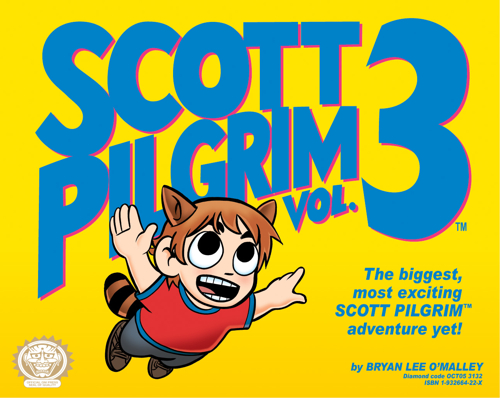
Remember how, a couple of weeks ago, I enjoyed Scott Pilgrim as a comic but had some misgivings? In Scott Pilgrim vs. the World, Edgar Wright has taken all of the aspects that I had misgivings about and vomited them onto the screen as a candy-coated exercise in overstimulation.
Yes, meth amphetamine laced cinematic upchuck, liberally applied to a silver screen near you! I know that I’m going to get in trouble for this (realistically I’m not, because no one is going to care what I think), but I really did not enjoy Scott Pilgrim vs. the World.
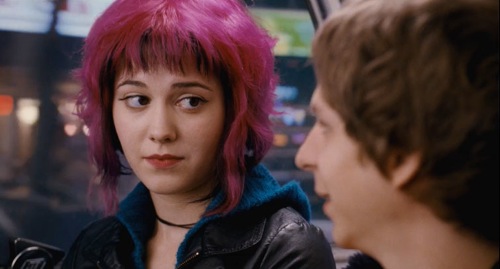
There is too much … Everything. Except, naturally, where there’s not enough of anything. Imagine for a moment that you have to fight seven evil exes. Now imagine that you’re fighting them because you saw a girl with pink hair. That’s the only reason you’re fighting them. You don’t know anything about this girl besides her hair colour.
Thing is, you’re never going to know anything about this girl. It’s not in the script. It was never going to be in the script. What you want is break neck set pieces that get remarkably samey after a while.
Why should you give a good goddamn? It’s your beloved Michael Cera! He’s talking about video games and punching people! You know all about video games! You wish you could quell your simmering rage with the application of fists to flesh! That’s all you need in a film! You are, vicariously, Michael Cera! You've got to lose your virginity before graduation or the world will end!
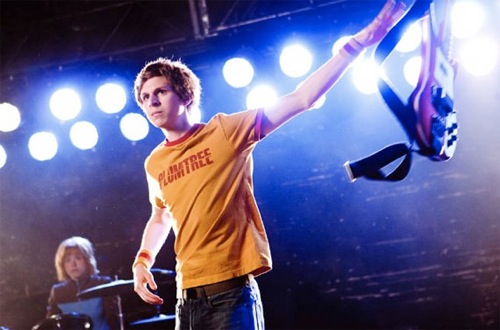
The first, and most fundamental, problem with the movie is in the title: Wright and co writer Michael Bacall have taken the character of Scott Pilgrim and rewritten him into Michael Cera. Scott Pilgrim is supposed to be manic, enthusiastic and a little dumb: a fool who always lands on his feet, and a lovable one at that. That is to say, not Michael Cera.
I've always been more of a Michael Cera apologist than most, but this was the point that I realised that he must be stopped. Cera is not making an effort to refine his shtick; with each passing movie a wheel will fall off the Michael Cera wagon until eventually he loses control and is pitched off a cliff into oblivion.
Cera could stand to learn from co-star Jason Schwartzman, who has always been recognizably Schwartzman but with a career diverse enough and movies memorable enough for it not to matter. One goes to a movie because they enjoy Schwartzman's work, but I can't imagine anyone ever doing that for Cera's sake; I'm convinced that a lot of people are seeing Scott Pilgrim vs. the World in spite of, rather than because of, Cera's involvement.
Normally if I love a movie I think, but never say out loud, "this is why I love movies.†Scott Pilgrim vs. the World actually embodies a lot of what I hate about movies. I love "movie moviesâ€, but this is a "movie movie†that tries very hard to stamp its filmic nature all over you, while simultaneously trying to assert its video game and comic credentials. It succeeds at precisely none of these ventures.
My friend Raymond said that he enjoyed the film because it was "new and novelâ€, but that's exactly the problem with Scott Pilgrim vs. the World: it really isn't anything that you haven't seen done before and done better. Inserting on screen energy bars and pee meters does not make your movie a video game. Putting sound effects on screen and constantly splitting the screen into "panels†does not make a movie a comic book. It didn't work for Ang Lee in Hulk and it doesn't work for Wright here.
A big deal is made of the fact that this movie is the ultimate video game experience. After Elton offered the headline "as Interesting as Watching Someone Else Play a Video Gameâ€, which is blatantly untrue: given the right game and the right player, watching someone else play a video game is akin to an artform. Observe me playing Dead Rising or Uncharted and tell me you're not having a good time and I'll call you a goddamn liar.
To say that a film is like a video game is normally reserved as "the ultimate insultâ€, which doesn't make much sense because video games are good and have their own place in society. Some complain that video games are becoming too cinematic, to which I say "pshawâ€.
There is nothing saying there cannot be a perfect fusion of both film and game, but Scott Pilgrim vs. the World is most assuredly not it. There is only one video game conceit that works properly here, and that is the 1-Up. Even that was used better, and more deftly, in the comic. I will also make a concession for the coin outlines in the Chaos Theatre, because they were kind of cool, but by that point in proceedings they were way past second hand.
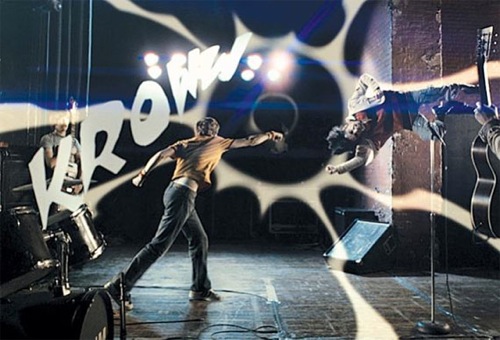
We have bred a culture that shuns the original and gleefully embraces the derivative and referential: Scott Pilgrim vs. the World is the embodiment of this sort of laziness. It gets off to a promising start with its application of music from A Link to the Past, but then it overeggs the pudding: potent elements are applied too liberally, and they eventually become bland, intrusive and even tiresome.
You have a Zelda reference. It sends chills down your spine because it appropriates something that you know and love into an exciting new context. It is good. Thing is, a few minutes later, there's another Zelda reference. And another. You're used to seeing Zelda applied to Scott Pilgrim at this stage, and consequently the reference has been rendered meaningless. Zelda has not been normalized; rather, you've been desensitized to Zelda. This is a tragedy in anyone's books.
You have an underworked reference to Double Dragon, you have a pretend video game ("Ninja Ninja Revolutionâ€) that implies that Edgar Wright somehow doesn't know how a video game works (when you win, an arcade game should not ask you for more money if you want to continue … the whole point is that you've defeated the game and you only spent 25 cents in the pursuit of that victory), which I am sure is the opposite of his intent. Video games get misrepresented in movies often enough that one would think someone who actually plays them would be adamant about getting them right.
A key element of pop culture nihilism is that the audience "gets†the material and knows that the authors are throwing them a knowing wink. It's the mutually assured destruction of original thought. That Wright would so clumsily grapple with a basic conceit of the video game form lends yet another layer of disingenuousness to an already deeply dishonest film.
In this sort of work, little things are just as likely to annoy as much as the big things. Why, for instance, do Crash and the Boys get killed off in a throwaway gag when it would be easier to leave them alive simply because it wouldn't upset anyone (i.e. me)? It's because Wright has tried to give the story a cleaner through line: he wants Sex Bob-omb to have a goal, to win a battle of the bands and to get a recording contract.
As a result, most of the variety of the comic is lost. Three of the seven battles involve Scott playing music and then punching people, or the other way around. Sex Bob-omb's music is supposedly provided by Beck but Beck has done a great job of making his music sound like so much noise. You get to enjoy it for the bass battle! And the twins battle! While you're witnessing them, you notice that the sounds are totally indistinct. The obnoxiousness is nowhere near the level of Michael Bay, and it's always easy to see what's happening, but it's damn near impossible to care about any of it.
The majority of the fights are massively predictable. Of course you know that Scott is going to win them, but not every battle should run "looks like Scott's winning! Oh wait, now the evil ex has got him! How will Scott survive?! REVERSAL KO!â€
When they're not predictable, they are stupid. "Demon Hipster Chicks†are as discordant here as they were in the first instance, but their tomfoolery is compounded by Matthew Patel launching into an "Indian dance†for easy laughs based on cultural stereotypes (the best kind of laughs!). Lucas Lee, at least, isn't too poorly handled except he's dispatched too quickly. The worst offender is Roxy, who has been so violently mistreated by the film that Mae Whitman should probably have complained. That is not how you defeat a half-ninja, Edgar Wright, and you damn well know it.
Wright has colossally mismanaged the passage of time in the film, with almost no down time between most scenes. When Scott isn't lamely wooing Ramona, he's lurching from one evil ex to the next. It really doesn't feel like Scott has any life outside of the fight, to the point that the only reason he's shown walking anywhere is so a half-ninja can attack him. It feels like he's only placed in scenes to trigger plot advancement, which seems considerably less than natural. A movie should never feel like it's on rails; it should feel like the rest of the world is outside the confines of the narrative, and we simply don't see it. Scott Pilgrim exists in a bubble. Every character exists solely for his convenience, to boost him. None of them have their own lives outside of Scott's Precious Little Life. I understand that this is a movie, and it doesn't have room for everything, but look at it like this: all of these characters are Michael Cera enablers. No one should enable Michael Cera. He is a monster.
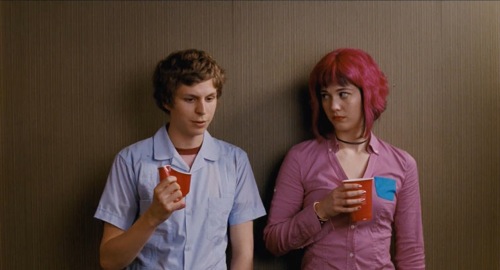
Ramona Flowers was never much of a character to begin with. She was always an object for Scott to doggedly pursue. Mary Elizabeth Winstead somehow brings less to the character than the little that was there in the first place (I checked a few panels and saw that in the comic, at least, she had facial expressions and the good grace to be embarrassed by her past). I hate the gimmick of instant love. Scott has no reason to have any interest in Ramona and even less to fight her League of Evil Ex-Boyfriends.
The already poorly explained sway Gideon has over Ramona in the comics is even more lazily treated in the film. A stupid prop is all she gets by way of justification for her actions and somehow everything is forgiven. Jason Schwartzman is a good Gideon and the best parts of the finale are those taken directly from the final volume (which was incomplete at the time of filming), but the whole thing is clumsily handled. The whole film is clumsily handled, so slickly that it's amazing none of the actors slipped over and face planted in production.
Believe me, every actor except for Cera tries (and Winstead just isn't given enough to work with to bother trying to make a go of it), and they are mostly successful. Brandon Routh as Todd Ingram has the most thankless task of all with deliberately painfully clumsy dialogue, which is less "funny†than it is "painfully clumsyâ€. If you're laughing it's because you just want the scene to be over; for some reason, this particular spot of dialogue was deemed fit to make it into the trailers.
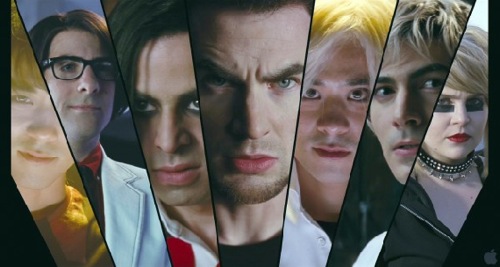
Similarly, Chris Evans is given such direction that suggests he's playing less of a person than he is a syncopation machine, but that's not his fault. He does what he can with his singularly lacking material, and the worst of it is that he isn't even the most shortchanged character. Of the exes, that's a tie between Roxy and the Katayanagi Twins.
Why the Katayanagi Twins have their robots replaced with keyboards is entirely beyond me, because people like me (i.e. nerds, your key demo!) are supposed to love robots. O'Malley knew how to escalate drama and stakes, and volume five was the most dramatic volume of Scott Pilgrim at the time of its publication. The Katayanagi Twins are little more than an afterthought, resentfully jammed in by Wright for appearance's sake, when in reality they should have brought gravity to proceedings. Instead, Cera's Pilgrim is allowed to float away on a cloud of his own smugness … not a character, but just a jealous Cera like so many other teen protagonists before him (and yes, I know he's supposed to be 22).
Kieran Culkin brings a tiny ray of sunshine to proceedings with his portrayal of the super gay Wallace Wells, but he brings a different brand of gay to proceedings than his inky counterpart. Wallace manages to provide most of the films more legitimate laughs and it's good to see that a movie made to appeal to video game nerds featuring men making out without saying "ewww†about it. That's the best that can be said, because Culkin is also given unfortunate "reaction†shots, which means for parts of the movie he is relegated to the role of the "gag animal in a J-Lo movieâ€, the most shameful role that any actor can ever be asked to perform.
Anna Kendrick does well in the seemingly expanded role of Stacey Pilgrim, the normally funny Aubrey Plaza is painful in the role of Julie Powers (ahahaha, we've CENSORED HER SWEARING AND THE DIALOGUE DRAWS ATTENTION TO THE FACT), and Alison Pill is really rendered fourth tier as Kim Pine.
Ellen Wong probably comes off best as Knives Chau, although some of her material is simply embarrassing (the wafting "love†is not the least of it), and they've done strange things to make her augment the existence of Johnny Simmons' Young Neil (who in some ways is a different character thanks to the changes in plot structure).
Similarly, Brie Larson is perfect as Envy Adams but unfortunately the character itself has been assassinated. You know how at the end of everything characters are supposed to learn vital lessons from those around them? Envy isn't given a chance. She's just left hanging, and consequently Scott has even less of a character than he had a right to have … and that's one thing that's entirely not Cera's fault.
Scott Pilgrim vs. the World is less than a bubblegum film: it loses its flavour shortly after the opening credits sequence, when you realise it's not going to get any better. There's just going to be more Zelda music, two separate but identical Cera-excruciating "Scott explains the origins of Pac-Manâ€, more faux-DDR jokes, and the pounding of lesbians into the ground.
It's the sort of movie that ambushes you later: you're sitting around minding your own business and then you're reminded of, say, the Seinfeld sequence (there's seriously a Seinfeld sequence) and you cringe. You're supposed to remember an isolated part of a movie (example: Wright's own Hot Fuzz … "I don't wanna be Judge Judy and executor!â€) and smile or laugh at the thought of it. Scott Pilgrim vs. the World is a head-shaking movie characterized by regret at what never should have been.

I suspect that my stance on Scott Pilgrim vs. the World is going to be unpopular. I don’t care about the whole hipster thing: everyone hates hipsters so much that I’m not convinced that they actually exist. Scott Pilgrim vs. the World does not embrace hipsters, but rather a demographic. This movie embodies modern popular culture, which is to say that it is a mirror facing another mirror; it is an endless corridor devoid of meaning.
At one point I considered saying that Scott Pilgrim vs. the World is basically a cinematic version of Family Guy, but I realised that is something I would never be able to take back. I genuinely respect Edgar Wright and loved his last two films. I want Scott Pilgrim vs. the World to do well not because I liked it – and I think you can tell that I assuredly did not – but because I would like to see more films from him. Shaun of the Dead had a legitimate heart … the shot that Shaun had to take inside the Winchester horrified and saddened me even as it made others laugh awkwardly – and Hot Fuzz was the second best mainstream homosexual romance comedy of the 2000s, after Superbad.
More films are going to be made like this, and worse. If zeitgeisty films like Zombieland can sidestep annoyance (let's not talk about the Eisenberg Principle), there's no reason that Scott Pilgrim vs. the World could not have done the same.
In Shaun of the Dead, Wright undeniably helped to pave the way for the zombie and vampire mania of the modern age, but here has bitten off far more than he can chew. Cramming six books into 113 minutes, the first thirty of which are approximately 75% of the first volume, he has left the film with the sound and myself with the fury.
This isn't simply a case of Scott Pilgrim vs. the World being a bad adaptation of the comic … and it is undeniably that … it's about Scott Pilgrim vs. the World being a plainly bad movie. Noisy, heartless and empty, it is the perfect symbol of the worst excesses of modern pop culture. If this is what my generation is supposed to worship, I'm going to excuse myself … and I'm not going to go quietly.