Wicked – Capitol Theatre, September 6 2009

Wicked is one of those ridiculously popular Broadway and West End musicals, and it made its way to Australia last year. Just yesterday it opened in Sydney, the second tier musical town in Australia (as far as I can tell, there are no tiers after that). I caught the matinee Sunday performance, and it was amazing even in day time.

Wicked is what happens when you take strong, resonant source material … both Gregory Maguire's book and the Wizard of Oz itself … set it to music, and then have it performed by a strong cast and, uh … Bert Newton.

A great show all around and a great production, Wicked is definitely something that should be seen if you like musicals. If you don't, there's probably no helping you.

Up

Pixar is one of the greatest film studios presently in operation. They are a studio with a consistent vision and a strong distaste for making the same film twice. Above all, they don't just make great animation, they almost always make great films. Pixar is a studio captained by people with a deep respect for every aspect of their craft, and they have impressed once again with Up, which finally sees release in Australia this month.

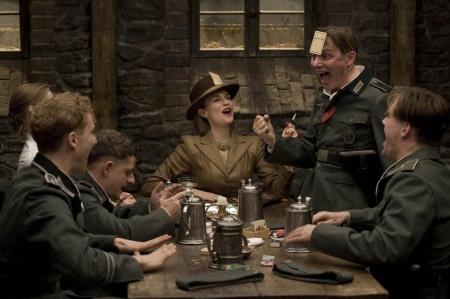
Inglourious Basterds

Am I the story of the Negro in America?

I had to see Inglourious Basterds twice to properly appreciate it. The first time was one beset with hang ups: expectations of a film, expectations of history; I came away from it thinking that it had great moments but was uncertain as to its quality as a whole movie. It turned out that the film has great moments, yes, sequences of incandescence that outshine its remainder; thing is, the remainder is still almost as great. It’s now safe for me to say that Inglourious Basterds is an unqualified success: a blissful piece of film making and a great film on top of that. If it took me a week to realise that, it’s my own fault.

When Twitter Fails, They Don’t

Earlier on Twitter I lamented the cult that has risen around Joss Whedon. Two people tried to slap me down for it. Then I remembered tonight that “The Trio” existed, and that this is a bad thing indeed and I was entirely right to be critical.

Twitter’s down, so I’m sharing it with you here.

Coming soon: Coraline (written but not edited; a good film!); the awful state of children’s film based on trailers (“Say Hello to my Little Friend!”); Funny People (when I find out when the damn thing is out here) and finally, GI Joe, which I’ve already lined up tickets for.

Public Enemies

Public Enemies is not, as I was informed the day that I saw it, "the worst movie ever”. It's not a particularly good movie, but it's not a bad movie. The most accurate word for Public Enemies is "flat”. In a few more words, I would go on to describe the cinematography as "extreme close up HD shaky cam”. One of the best things that Spielberg, for example, does in his treatment of period film is to make them feel as if they were made in the time they're set; Munich, despite whatever else you might say about it, felt like a seventies film.

While there are obvious aesthetic and practical considerations to take into account in the making of a period piece set in the twenties (Clint Eastwood did a pretty good job in Changeling), Michael Mann's choice to shoot Public Enemies in HD and with such proximity to the actors divorces the film from the audience. Alienating the audience with cinematography is not a good idea when you've chosen to tell an interesting story in an unengaging fashion, eking flat characterisation out of normally talented actors.

Public Enemies had the chance to have it all: bank robberies! Johnny Depp! Style! Panache! It's not dull and it's not a bad movie, but it simply doesn't work. It's a movie that asks its audience to sit there and watch for two and a half hours. Their eyes won't slide off the screen, but will they give a damn about what they're seeing? It would be a tough gambit for the studios, but this is a movie where the poster is better than the finished product; good promotion and a good cast will carry it so far, but how will it fare on word of mouth here in Australia?

Greedo Shot First

The idea that Han Solo didn't shoot first is poorly implemented in the Star War Special Edition. It seems that, in 1997, George Lucas got Han Solo confused with Indiana Jones: Han is a man primarily interested in personal gain who eventually gets his heart softened by the triplet allures of love, justice and deus ex machina; Indy is an adventurer who firmly believes that things belong in museums. Surely Han couldn't do something so dirty as to shoot a dude unprovoked, Lucas must have thought. No, that's not Han at all; the Han I know chills with moon teddy bears and claps around campfires with Billy Dee Williams[1].

This theory doesn't entirely stand up in light of Indy simply shooting the guy who came at him with a scimitar in Raiders, but Lucas has never been known for his consistency, not even in the days when he had credibility as a film maker and story teller.

In light of Lucas' waning, never before have the words "Greedo shot first” been so true, so weird, or so paradoxical: this insane piece from Charlie Jane Anders examines what would have happened in a bizarro world where movies are rendered pointless but also somehow …gooder? (That word is as real as this theory!)

This hypothetical draws so heavily on knowledge of the Star Wars universe and its characters that one wonders how it would have made any sense if it were the original version of events. The best part is that it heavily references the prequel trilogy, which is great for two reasons: it assumes that Lucas had actually thought of any of this stuff at the time he made A New Hope; and, having prepared three movies before A New Hope, Lucas decided to neglect all of that in favour of Greedo killing everyone who got in his way, thereby conquering the galaxy.

Actually, that does kind of make sense. Also worthy of note is the fact that Greedo somehow manages to get directly from being pulled aboard the Death Star to rescuing Leia, which I recall having been at least slightly difficult for a team of two seat-of-the-pants professionals, a farm boy and a pair of droids. But hey, he's Greedo. He makes the trains run on time, he managed to wear a suit that was probably actually integrated into Vader's biometric systems, and he restores peace to a galaxy which apparently has a murderous law of succession.

The real question is "why not?” I have no satisfactory answer. Greedo shot first.


[1] I am forever going to be inexplicably angry that the final shot of the Star Wars saga features Billy Dee Williams clapping with ewoks.

“The City”, Sydney Theatre Company, 28 July 2009

It’s dangerous to refer to a situation in a play as “awkward and artificial”, because there is a very real possibility that the audience will conflate the comment with the play itself. Martin Crimp's The City is one such play, a sort of Synecdoche, New York Jr that doesn’t make you question reality so much as it makes you question whether you could be bothered to take anything at more than face value.
I’m inclined to believe that it’s a collection of interesting parts in search of a whole to be the sum of. A stage consisting of nothing but uncomfortably steep steps that is occasionally bathed in complete darkness asks the audience to accept contextual clues as to where we are: it scarcely matters, because we’re always somewhere around the house of two people whose names are irrelevant. It looks like they’re uncomfortable, and this is likely the case.

The City amounts to a collection of monologues masquerading as conversations between a married couple, their eight year old daughter and their neighbour over the course of a year, presumably in this time of Global Financial Crisis (man, I can hardly wait for the GFC to be over).

The monologues are interesting, covering as they do the wife’s trip to a book festival, the husband’s encounter with a boy he had bullied in his school days and, most interestingly and inexplicably, the involvement of the neighbour’s husband in a secret army carrying out a secret war in a secret city, killing everyone inside so that they can then go in and kill the remainder of citizens “clinging to life”. Sometimes the monologues are even related to each other, if we’re lucky – but they are essentially selfish pieces of work.
The thing is that The City is puzzle theatre, and puzzle theatre doesn’t work so well when you couldn’t be bothered to solve the puzzle. The actors acquit themselves well, although I continue to feel awkward whenever actors shout in a play and go red in the face. The "awkward and artificial” line can definitely be applied here, particularly as the dialogue is written in a self conscious mode of constant clarification of meaning and motivation. It’s plainly supposed to be how people “really” talk, but part of the point of movies, plays and books is that they represent the real rather than actually being real. Fictive performance is replication; more real than real.

In trying to both appear real and to make the audience question reality, The City divorces itself from both the audience and the play's "duty” to maintaining the illusion of reality. It’s interesting but nothing else. It’s hard to know how we’re supposed to take characters who we can’t gauge the meta-levels of.
This was an instance where it really felt there was, more than a fourth wall, a glass screen between the audience and the performer. Reading the program, it seems that this was Crimp's intent, so I suppose that, on some level, The City was a success.

Macross Frontier

You may recall that I used to maintain an anime blog. Becoming disillusioned with modern trends in animation and fandom in general, I cut down my consumption and severed myself from all involvement with the community. Since then I've become a little more comfortable with my place and figure that it can't hurt to say a little every once in a while.

These words exist in my own canon, and perhaps one day I'll be able to participate on a world stage once more. I'm absorbing future anime writing into the body of Batrock.net for a less splintered presentation of my interests.

The original Macross series is one of my favourite of all time. The combination of civilian life with space warfare and compelling villains, with more emphasis on music than was usual at the time, made for a memorable series that has endured far longer than its arbitrary "brothers”, Southern Cross and Mospeada. Due to the convergence of several sets of circumstance, a couple of weeks ago I got the chance to watch the 25th anniversary series, 2007's Macross Frontier.

My stance on Macross Frontier is complicated: sometimes I thought that it was a Macross series only cosmetically, and at others I thought that it captured key themes perfectly. Despite the lack of depth to the villainy and the frequently workmanlike action sequences, I think that overall it captured very well the essence of animated science fiction.

I do not consider the following to contain very specific spoilers, but I do comment on the outcome of the love triangle.

MGMT’s “Kids”: Nightmares for All

A while back, I got interested in MGMT. They programmed an episode of Rage, and included their own video for “Electric Feel” – both tribal and beautiful. So now they’ve come out with “Kids”, featuring a one minute prologue followed by five nightmarish minutes of a child tormented by monsters.
It’s interesting, if you like their sort of music (which, according to Wikipedia, can be classed as “Indie Rock”, “Synthpop” “Dance-punk” and “Psychedelic Pop”, suggesting they’ve got no idea what it is either). The director is also apparently part of the team who made Where The Wild Things Are:

I take Joanna Newsom’s appearance as the inattentive mother of this child to be a tacit endorsement of MGMT’s efforts. It also goes to show that a lot of the time I have to wonder what “the deal” is with music videos. The ones that grab my attention probably don’t actually “mean” anything, but they engage the eyes and, if I enjoy the music, I look into it further. My way of life isn’t exactly conducive to stumbling across videos, but they can strike in the most unexpected of places and ways.

What I’m trying to say here is that when I heard Soulja Boy’s “Crank Dat” at a law firm’s reception, my life was changed. No, really. (Not really). It would perhaps be more accurate to say that I still remember the first time I consciously came upon Scissor Sisters, and that was one of many pebbles that started an avalanche that irrevocably changed the way I live today.

The works of Lady Gaga could possibly justify a PhD thesis by this point, and I might get to them later. For now I should make it clear that the child in the video is crying, but he was totally cool with the monsters. Apparently they’re tears of fatigue or something, so I guess baby labour camps are tough work.

GI Joe: A New Hope for Summer

How great is GI Joe: The Rise of Cobra going to be? With my barely concealed distaste in this "summer” season (bearing in mind that Australians won't see Up until September), I'm going to take GI Joe's tagline to heart: "When all else fails, they don't”.

Look at it this way: it’s bright and crisp. It looks like the special effects had enough of a budget to appear both special and effective. It doesn’t look like it takes itself too seriously, as evidenced by the villain being Christopher Eccleston (the Ninth Doctor!) eating scenery, combined with Joseph Gordon Levitt in fetish gear (although I don’t think that’s shown in this trailer).

I think that one of the many problems with Transformers is that it takes itself so damned seriously, and Michael Bay is convinced that he has made “art”. Shia LeBoeuf sees his character as so identifiable it’s scary.
Megan Fox, on the other hand, has been the only person publicly out of the machine, admitting that it’s not art, and that she needs hard liquor to fill the void in her soul created by watching the movie.

Imagine, if you will, that GI Joe was produced by a team of Megan Foxes. People who knew they weren’t making art, but were instead focused on having as much fun as they possibly could on the ultimate in ridiculously over-budgeted ($170 million!) bubblegum cinema.
It might not be the case here, but come on. We can only take so many terrible self important movies before we want to chew on a movie that is aware of what it is, of its limitations, and has decided to make us laugh, intentionally or not.
To be entirely honest, when I was at the cinema and I saw the submarines approaching the base at the trailer’s beginning, I was intrigued. Then I found out that it was GI Joe and my natural cynicism kicked in, but the trailer editor had done his job. I could no longer totally discount the piece.

GI Joe might not be good by any objective measure except one: it will be better than Revenge of the Fallen. Don’t let me down, Dennis Quaid. When all else fails, you don’t.