Public Enemies

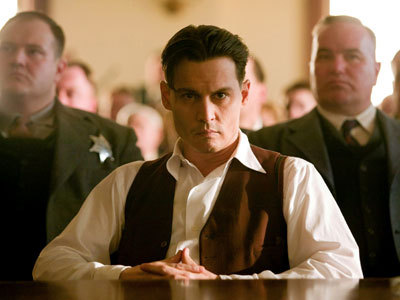
Public Enemies is not, as I was informed the day that I saw it, "the worst movie ever”. It's not a particularly good movie, but it's not a bad movie. The most accurate word for Public Enemies is "flat”. In a few more words, I would go on to describe the cinematography as "extreme close up HD shaky cam”. One of the best things that Spielberg, for example, does in his treatment of period film is to make them feel as if they were made in the time they're set; Munich, despite whatever else you might say about it, felt like a seventies film.

While there are obvious aesthetic and practical considerations to take into account in the making of a period piece set in the twenties (Clint Eastwood did a pretty good job in Changeling), Michael Mann's choice to shoot Public Enemies in HD and with such proximity to the actors divorces the film from the audience. Alienating the audience with cinematography is not a good idea when you've chosen to tell an interesting story in an unengaging fashion, eking flat characterisation out of normally talented actors.

Public Enemies had the chance to have it all: bank robberies! Johnny Depp! Style! Panache! It's not dull and it's not a bad movie, but it simply doesn't work. It's a movie that asks its audience to sit there and watch for two and a half hours. Their eyes won't slide off the screen, but will they give a damn about what they're seeing? It would be a tough gambit for the studios, but this is a movie where the poster is better than the finished product; good promotion and a good cast will carry it so far, but how will it fare on word of mouth here in Australia?

Greedo Shot First

The idea that Han Solo didn't shoot first is poorly implemented in the Star War Special Edition. It seems that, in 1997, George Lucas got Han Solo confused with Indiana Jones: Han is a man primarily interested in personal gain who eventually gets his heart softened by the triplet allures of love, justice and deus ex machina; Indy is an adventurer who firmly believes that things belong in museums. Surely Han couldn't do something so dirty as to shoot a dude unprovoked, Lucas must have thought. No, that's not Han at all; the Han I know chills with moon teddy bears and claps around campfires with Billy Dee Williams[1].

This theory doesn't entirely stand up in light of Indy simply shooting the guy who came at him with a scimitar in Raiders, but Lucas has never been known for his consistency, not even in the days when he had credibility as a film maker and story teller.

In light of Lucas' waning, never before have the words "Greedo shot first” been so true, so weird, or so paradoxical: this insane piece from Charlie Jane Anders examines what would have happened in a bizarro world where movies are rendered pointless but also somehow …gooder? (That word is as real as this theory!)

This hypothetical draws so heavily on knowledge of the Star Wars universe and its characters that one wonders how it would have made any sense if it were the original version of events. The best part is that it heavily references the prequel trilogy, which is great for two reasons: it assumes that Lucas had actually thought of any of this stuff at the time he made A New Hope; and, having prepared three movies before A New Hope, Lucas decided to neglect all of that in favour of Greedo killing everyone who got in his way, thereby conquering the galaxy.

Actually, that does kind of make sense. Also worthy of note is the fact that Greedo somehow manages to get directly from being pulled aboard the Death Star to rescuing Leia, which I recall having been at least slightly difficult for a team of two seat-of-the-pants professionals, a farm boy and a pair of droids. But hey, he's Greedo. He makes the trains run on time, he managed to wear a suit that was probably actually integrated into Vader's biometric systems, and he restores peace to a galaxy which apparently has a murderous law of succession.

The real question is "why not?” I have no satisfactory answer. Greedo shot first.


[1] I am forever going to be inexplicably angry that the final shot of the Star Wars saga features Billy Dee Williams clapping with ewoks.

“The City”, Sydney Theatre Company, 28 July 2009

It’s dangerous to refer to a situation in a play as “awkward and artificial”, because there is a very real possibility that the audience will conflate the comment with the play itself. Martin Crimp's The City is one such play, a sort of Synecdoche, New York Jr that doesn’t make you question reality so much as it makes you question whether you could be bothered to take anything at more than face value.
I’m inclined to believe that it’s a collection of interesting parts in search of a whole to be the sum of. A stage consisting of nothing but uncomfortably steep steps that is occasionally bathed in complete darkness asks the audience to accept contextual clues as to where we are: it scarcely matters, because we’re always somewhere around the house of two people whose names are irrelevant. It looks like they’re uncomfortable, and this is likely the case.

The City amounts to a collection of monologues masquerading as conversations between a married couple, their eight year old daughter and their neighbour over the course of a year, presumably in this time of Global Financial Crisis (man, I can hardly wait for the GFC to be over).

The monologues are interesting, covering as they do the wife’s trip to a book festival, the husband’s encounter with a boy he had bullied in his school days and, most interestingly and inexplicably, the involvement of the neighbour’s husband in a secret army carrying out a secret war in a secret city, killing everyone inside so that they can then go in and kill the remainder of citizens “clinging to life”. Sometimes the monologues are even related to each other, if we’re lucky – but they are essentially selfish pieces of work.
The thing is that The City is puzzle theatre, and puzzle theatre doesn’t work so well when you couldn’t be bothered to solve the puzzle. The actors acquit themselves well, although I continue to feel awkward whenever actors shout in a play and go red in the face. The "awkward and artificial” line can definitely be applied here, particularly as the dialogue is written in a self conscious mode of constant clarification of meaning and motivation. It’s plainly supposed to be how people “really” talk, but part of the point of movies, plays and books is that they represent the real rather than actually being real. Fictive performance is replication; more real than real.

In trying to both appear real and to make the audience question reality, The City divorces itself from both the audience and the play's "duty” to maintaining the illusion of reality. It’s interesting but nothing else. It’s hard to know how we’re supposed to take characters who we can’t gauge the meta-levels of.
This was an instance where it really felt there was, more than a fourth wall, a glass screen between the audience and the performer. Reading the program, it seems that this was Crimp's intent, so I suppose that, on some level, The City was a success.

Macross Frontier

You may recall that I used to maintain an anime blog. Becoming disillusioned with modern trends in animation and fandom in general, I cut down my consumption and severed myself from all involvement with the community. Since then I've become a little more comfortable with my place and figure that it can't hurt to say a little every once in a while.

These words exist in my own canon, and perhaps one day I'll be able to participate on a world stage once more. I'm absorbing future anime writing into the body of Batrock.net for a less splintered presentation of my interests.

The original Macross series is one of my favourite of all time. The combination of civilian life with space warfare and compelling villains, with more emphasis on music than was usual at the time, made for a memorable series that has endured far longer than its arbitrary "brothers”, Southern Cross and Mospeada. Due to the convergence of several sets of circumstance, a couple of weeks ago I got the chance to watch the 25th anniversary series, 2007's Macross Frontier.

My stance on Macross Frontier is complicated: sometimes I thought that it was a Macross series only cosmetically, and at others I thought that it captured key themes perfectly. Despite the lack of depth to the villainy and the frequently workmanlike action sequences, I think that overall it captured very well the essence of animated science fiction.

I do not consider the following to contain very specific spoilers, but I do comment on the outcome of the love triangle.

MGMT’s “Kids”: Nightmares for All

A while back, I got interested in MGMT. They programmed an episode of Rage, and included their own video for “Electric Feel” – both tribal and beautiful. So now they’ve come out with “Kids”, featuring a one minute prologue followed by five nightmarish minutes of a child tormented by monsters.
It’s interesting, if you like their sort of music (which, according to Wikipedia, can be classed as “Indie Rock”, “Synthpop” “Dance-punk” and “Psychedelic Pop”, suggesting they’ve got no idea what it is either). The director is also apparently part of the team who made Where The Wild Things Are:

I take Joanna Newsom’s appearance as the inattentive mother of this child to be a tacit endorsement of MGMT’s efforts. It also goes to show that a lot of the time I have to wonder what “the deal” is with music videos. The ones that grab my attention probably don’t actually “mean” anything, but they engage the eyes and, if I enjoy the music, I look into it further. My way of life isn’t exactly conducive to stumbling across videos, but they can strike in the most unexpected of places and ways.

What I’m trying to say here is that when I heard Soulja Boy’s “Crank Dat” at a law firm’s reception, my life was changed. No, really. (Not really). It would perhaps be more accurate to say that I still remember the first time I consciously came upon Scissor Sisters, and that was one of many pebbles that started an avalanche that irrevocably changed the way I live today.

The works of Lady Gaga could possibly justify a PhD thesis by this point, and I might get to them later. For now I should make it clear that the child in the video is crying, but he was totally cool with the monsters. Apparently they’re tears of fatigue or something, so I guess baby labour camps are tough work.

GI Joe: A New Hope for Summer

How great is GI Joe: The Rise of Cobra going to be? With my barely concealed distaste in this "summer” season (bearing in mind that Australians won't see Up until September), I'm going to take GI Joe's tagline to heart: "When all else fails, they don't”.

Look at it this way: it’s bright and crisp. It looks like the special effects had enough of a budget to appear both special and effective. It doesn’t look like it takes itself too seriously, as evidenced by the villain being Christopher Eccleston (the Ninth Doctor!) eating scenery, combined with Joseph Gordon Levitt in fetish gear (although I don’t think that’s shown in this trailer).

I think that one of the many problems with Transformers is that it takes itself so damned seriously, and Michael Bay is convinced that he has made “art”. Shia LeBoeuf sees his character as so identifiable it’s scary.
Megan Fox, on the other hand, has been the only person publicly out of the machine, admitting that it’s not art, and that she needs hard liquor to fill the void in her soul created by watching the movie.

Imagine, if you will, that GI Joe was produced by a team of Megan Foxes. People who knew they weren’t making art, but were instead focused on having as much fun as they possibly could on the ultimate in ridiculously over-budgeted ($170 million!) bubblegum cinema.
It might not be the case here, but come on. We can only take so many terrible self important movies before we want to chew on a movie that is aware of what it is, of its limitations, and has decided to make us laugh, intentionally or not.
To be entirely honest, when I was at the cinema and I saw the submarines approaching the base at the trailer’s beginning, I was intrigued. Then I found out that it was GI Joe and my natural cynicism kicked in, but the trailer editor had done his job. I could no longer totally discount the piece.

GI Joe might not be good by any objective measure except one: it will be better than Revenge of the Fallen. Don’t let me down, Dennis Quaid. When all else fails, you don’t.

Christian Book Review: Sarah and Paul Have a Visitor

This post bears the Curtis Dickson Spiritual Seal of Approval!

In my youth, when I went to the optometrist I was always happy to wait because his reception had several Peanuts books on offer. I still go to the same optometrist, but now his selection of reading material is markedly different. Apart from a few Goosebumps books, which brought back fond memories of Christmases where I had to pretend to be pleased with the RL Stine paraphernalia my grandmother thrust upon me, I was surprised to find that they had turned away from the secular world.
My optometrist had started to stock Christian books for children.

An unforeseen wait ahead of me, I chose the forgotten 1989 classic Sarah and Paul Have a Visitor which promised I would “learn about Jesus!”

And learn I did. Of course, I’m entirely familiar with the sanitised version of Jesus offered by this book, as I did have religious education in my earlier days (apparently I asked for it, and my parents were never one to complain about packing me off to church on Sundays and to my youth group on Fridays while they did whatever it is parents do while their younger son is indulging in the works of Christ).  I'm even fairly, but not intimately, familiar with developments in Jesus study suitable for people over the age of twelve … which is useful when so much of Western fiction draws its inspiration from Judeo-Christian tradition, and when so much of Japanese anime and video game culture attempts to do likewise.

Synecdoche, New York

Synecdoche, New York is my favourite sort of movie: it exists on the edge of reality, its existence only confirmed by the fact that I saw it with a friend. It's also got another thing going for it that makes it harder to write about: the less that you know of Synecdoche, New York, the more liable you are to be surprised.

Either that or pissed off and feeling like Charlie Kaufman has wasted more than twenty years of your life. That's the beauty of the movies: you can feel strongly one way or the other. Hatred is still a response, and it's far better than apathy.

What's next for literature's enfant terrible, Jane Austen?

Are you familiar with Jane Austen? She's a promising young female writer with a strong following, perhaps best known for her seminal work Bridget Jones's Diary.

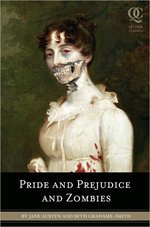
Turns out that she's taking the idea of olde timey romance and turning it on its head! Her first gambit is the zeitgeist shattering book Pride and Prejudice and Zombies, which effortlessly shoehorns a zombie infestation and battle into a perfectly serviceable story about a group of women who must be married off at all costs to rich landowners in order to save their silly mother's face. It must be successful, because I've seen at least three women reading it in public.

That's what they're all over these days: Edward Cullen and Mister Darcy. The latter, of course, is a master in the art of zombie killing and all around uptight jerkface with a heart of gold. So popular was this young upstart Austen's genre bending that she managed to claw her way to number three on the New York Times' best seller list before they realised that, as a woman, she didn't have the agency to warrant such a spot.[1]

Austen has decided to follow her surprise success with the release of Sense and Sensibility and Sea Monsters, which will apparently be about two recently impoverished sisters who seek love and heartbreak … and something else that I think the title hints at but I've yet to get an actual idea of. Austen is moving up in the world, though: Sense and Sensibility and Sea Monsters is an infinitely catchier title that doesn't even rely on the crutch of memes as a cynical grab for readers.

Okay, I just considered Jane Austen as an actual meme hound, even … gasp! … a channer, and my brain exploded. I was surprised to see so many copies of Seth Grahame-Smith's Pride and Prejudice and Zombies in real life. In my estimation it's the sort of book that you hear tell of online and then never again. Serious, unironic reading of a romantic classic spliced with zombie combat. I was surprised when I found out that this book is more than just a cash-in, because further reviews have revealed "(w)hat begins as a gimmick ends with renewed appreciation of the indomitable appeal of Austen's language, characters, and situations…”[2]

It's a relief, really. I've got nothing against messing about in the public domain: my mother and I enjoy a good bonnet drama, and this year the ABC televised Lost in Austen, a BBC miniseries about a woman who accidentally trades places with Elizabeth Bennet, "ruins” the story of Pride and Prejudice as it was supposed to happen, and falls in love with Mister Darcy herself after they both over what an arrogant prig he is.

It's a knee jerk reaction to automatically think that zombies are a bad idea in this day and age, but one can't really blame me. All of the cool things – pirates, monkeys, zombies, vampires, and ninja … have been spoiled by an internet hungry for something that I'm not entirely sure of. That this seems to be done with a sort of love and respect warms the cockles of my heart, and other such disposition changing cliché.

I didn't have that instant reaction to Sense and Sensibility and Sea Monsters. It may be that I'm getting less uptight in my old age, or it may be the fact that the open and gleeful stupidity of the title caught me entirely off guard. I'm not an Austen fanatic; in fact, I've never read one of her books, but I'm now comfortable in the knowledge that she's in safe hands. Sometimes the appearance of stupidity can mask a deep and abiding love, and  one that the world is just a tiny bit better for.


[1] Blatant sexism meant in jest; this "article” is a bizarre mishmash of satire and whatnot. I thought this would be obvious but I don't want people missing it and tearing me to pieces. Women continue to remain talented and valuable members of society.

[2]Donna Bowman, AV Club, "Pride and Prejudice and Zombies”, April 15 2009

My God – it’s devoid of stars: Futurama to be recast?

Cliché image, yes, but iconic.

The news of Futurama's return to television was a good thing, yes? If something worthless like Family Guy can claw its way back to prime time, surely a more deserving property like Futurama could be given another chance to shine?

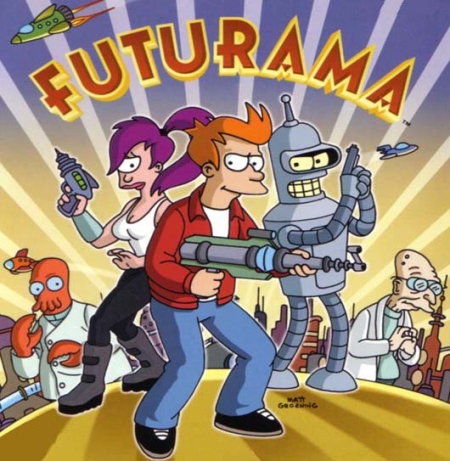
The revival has hit a rather sour development with the release of a casting call sheet. When I saw the news on io9 I was prepared to discount it. Delving deeper and seeing that call sheet, however, is pretty damning. I'm expecting this to explode all over certain quadrants of the internet, and for good reason: Billy West, Katey Sagal, John DiMaggio, Phil LaMarr and Maurice LaMarche are the crew of Planet Express and the people of the universe at large. They are an inextricable part of the show.

This is not like Daniel Craig succeeding Pierce Brosnan as James Bond. This is like someone killing one of your loved ones and replacing them with an android: it looks exactly like your dear old Grandmama, but it lacks her distinct personality and sounds ever so slightly off; an impersonator; an insult to the memory of someone important to you. Did no one at Fox see Changeling?

I don't see how Fox thinks they can get away with this. Part of the reason Futurama is coming back, perhaps even the entire reason, is that it has a following; people like Futurama. It has a strong and storied cast that endeared itself to audiences over 72 episodes and four movies (that I did not see) and it was genuinely funny a lot of the time.*
People who like Futurama like the cast, and anyone else is nothing more than a pale imitation. I understand replacing a voice actor for reasons of necessity:

  • Death (see: legacy characters like Mickey Mouse);
  • Retirement (see: Christine Cavanaugh);
  • They turn out to be a serial killer who has used their position to abduct fans at conventions and then murder them.

I can't see a legitimate reason for replacing an entire, more than amply talented, ensemble (not to mention Tress MacNeille and Lauren Tom!).

"Money” is not a legitimate reason, because I can imagine that people – myself included … would not be keen to watch a Futurama that has been senselessly neutered, and therefore a large amount of the anticipated revenue stream will have died.

What is the point of watching a science fiction cartoon composed of strangers whom no one would bother ever allowing into their hearts? This is a question I ax in all sincerity: I mean, seriously, what the hell? This is arse-backwards creative philosophy. Who cares if these actors don't write or animate the material? They are still their characters, and their job is more than simply standing in front of a microphone and speaking their lines. If your cartoon is good, then your actors are going to care about the characters they represent and that care is going to translate itself to the finished product.

The call sheet is particularly insulting:

"Descriptions of these established characters follow, along with links to clips of previous episodes for reference.”

(Emphasis mine)

Who established these characters? The fact that they're providing clips of previous episodes for reference confirms that they're not seeking a new direction: they're searching for cut-price impersonators. It's my impression that voice actors have a certain professional pride: who could honestly trample over the work of people who are plainly still capable of performing the work they've become known for?

Entirely apart from not understanding the situation, understanding why people get emotionally attached to a property, it seems that Fox don't even understand that some people have sensitive ears and will not simply deafly accept a change.

People obsess over voice actors; they follow their work across the years. I do it in both cartoons and anime, as another one of my hobbies: when I saw a trailer for Secret of Monkey Island featuring LeChuck's first mate, I said aloud "Hey, it's Rob Paulsen!”- and it frustrates me to no end that I can't find a cast list for the game to confirm my suspicions. This would not go unnoticed by weird hobbyists like me, and even less fanatic types would be bound to notice a replacement of the entire cast of a cartoon with a large following.

It's particularly amazing that this would happen on a Matt Groening property. Does no one recall the multiple times that they have attempted to kill cast members of The Simpsons? Even The Simpsons remembered it, in largely unremarkable episode Homer to the Max:

Homer: Networks like animation ’cause they don’t have to pay the actors squat!

Ned:    Plus, they can replace them, and no one can tell the diddly-ifference!

They then summarily jerked around Maggie Roswell, who ended up paying for the privilege of appearing on the show (her pay cheque wouldn't cover the cost of travel to recording). Marcia Mitzman-Gaven, her replacement, was probably a good voice actress in her own right, but as Maude Flanders and Helen Lovejoy she plainly sucked. They got around this problem by largely shutting Helen up and killing Maude in Alone Again, Natura-Diddly. Roswell is back now, but Maude is still dead.

Since then there has been a variety of industrial actions and talk of strikes, but the voice actors have continued to win out. I've heard The Simpsons is improving again (I haven't particularly cared to find out), but for the longest time there the established cast was all it had going for it.
Futurama is plainly not the juggernaut that The Simpsons has proven to be, but there are clear ethical, professional and fanbase considerations that apply. I'd like to think that the Futurama fan base is strong enough to convince Fox that this is an awful decision and they'd better turn this ship around instead of charting unexplored and counter-productive territory.

*This is entirely not the time to confess that a while back I went through a listing of all of the episodes and only really appreciated about half of them, the third and fourth seasons largely, but not wholly, falling flat for me.