Honey and Clover – episode one
May 8, 2005 on 10:39 pm | In Honey and Clover | Comments Off on Honey and Clover – episode one


This fan sub lark is fun!
I have no idea what this anime is about. I love it, but I have no idea what it is about.
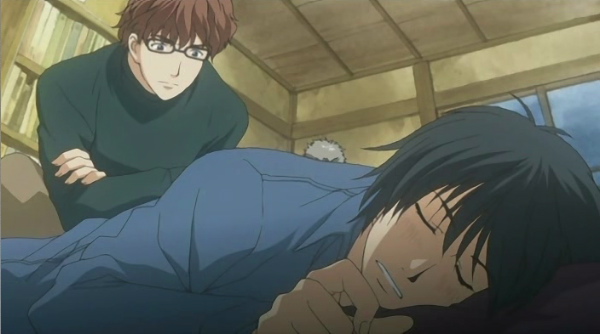
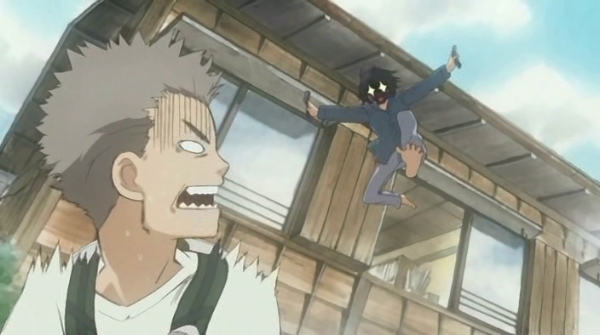
Honey and Clover begins as a story about a group of university students that live in a big old house. They get up to mischief. But then at the end a freaky little blonde girl who looks like she’s four but is actually 18 comes to visit, and now I could not tell you what’s going on.
Vandread the Second Stage
May 7, 2005 on 8:47 pm | In Vandread | Comments Off on Vandread the Second StageVandread the Second Stage takes place almost directly after the first series, with the increased danger of that conclusion looming. Where Vandread was a series about but one ship in space, The Second Stage is at once more vast and more personal.
Emma – episode 4
May 4, 2005 on 9:00 pm | In Emma | 1 Comment“Mudie’s”
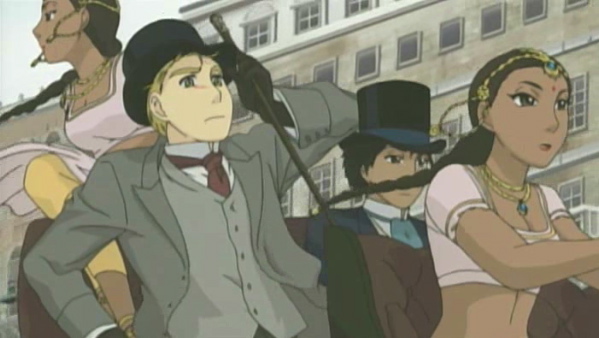
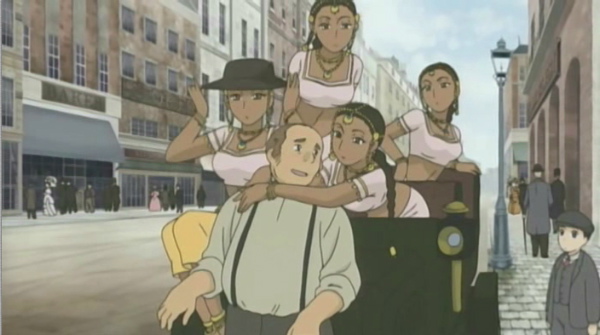
This episode left me in high spirits. Considering that I was preparing to murder the internet beforehand, this makes it a good outing. The Adventures of William and Hakim Emma is one entertaining series.

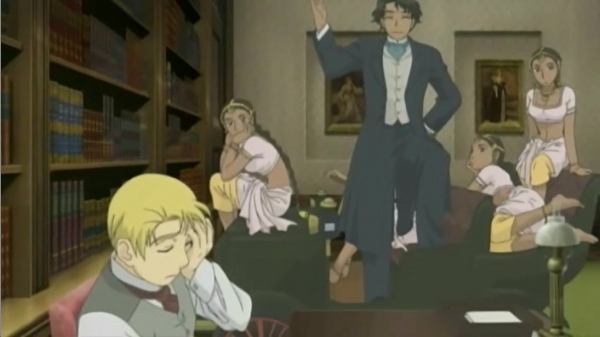
In this episode, Emma goes to Mudie’s library, where Hakim and William are browsing the Victorian pornography. Emma escapes with a blush and a book about a servant falling in love with her master: it’s all dreadfully romantic. After having been rejected by Emma, Hakim lets William know that the path is clear. This leads to the least painful William and Emma interaction so far!
This episode wasn’t big on plot, being as it was about Hakim’s displacement. Eleanor didn’t have any reaction to Hakim’s presence at all – but she did have a debriefing scene in front of her mirror, except that she has her maid to talk to. What was important here is Hakim’s harem. They are pretty much funny in whatever scene they are in. Their immobile features grow on you the more immobile they become, and there’s something inherently hilarious about one of them gunning a motorcar.
Also important in this episode is the inclusion of Arthur, William’s younger brother. Arthur seems to be the embittered child who actually has to make something of himself. “You’re inheriting the family business,” says he to William, “I can’t just loaf around like you.”
It’s true; William is the definition of a man of leisure. He has underpaid servants to do his work for him, so he can spend his days being awkward around the ladyfolk. If William did not have Hakim with him, this series would not be as fun because it would likely become apparent he’s a bit of a jellyfish. If one is to be a cad, they must have the courage to do it properly!
Did anyone notice that Emma gets very little screen time indeed.
A nice, enjoyable episode with a satisfying ending. But what’s up with the vehicles? They don’t look near as sharp as anything else in the program.
City Hunter 2 – 46 to 63
May 1, 2005 on 8:48 pm | In City Hunter | 1 Comment
City Hunter has its diehard fans. I would almost count myself as one of them. While it may have taken 100 episodes to get there, there was one truly awesome moment: a moment that I felt.
“Goodbye, Hardboiled City”, about a terrorist ring led by the mysterious “Sarah”, is one of the best Ryo and Kaori relationship stories there has ever been. It is exactly as if the writers had set out to fashion a heart-pumping City Hunter extravaganza. The action, the music choice … pure synergetic magic – and now certain things are out in the open, not drowned as in “Kaori has amnesia!”.
Even the fact that Ryo disarms a nuclear bomb by shooting a wire and hoping for the best cannot detract from this episode; the status quo doesn’t disappoint, either.
 What is disappointing is that this is followed by City Hunter‘s first recap episode, Crystal Prophecy, in which a fortune teller tells Kaori that she always puts Ryo in danger. It’s been a long time since I’ve seen one of these, and this one is pretty lame. The positive aspect is that most of the clips are from season one, so long ago I couldn’t remember them, but City Hunter does not work based on action alone; also, the few comedy bits make entirely no sense out of context. Umibozu as Colonel Sanders, sure; but why? The new animation is way off model – particularly Reika – and they try to make up for it all with a sweet Kaori and Ryo moment at the end, but by then it’s too late.
Of course, this episode can be summarised by my notebook: “What kind of crappy fortune teller tells the past?”
 The issue of Kaori knowing herself emerges in “Reunion After 20 Years”, wherein Kaori’s elder sister appears. It had been so long, I had quite forgotten that Kaori and Makimura were not blood relatives. The moral of this story (which is not not that Kaori looks good in a dress) is strong: does Kaori know her own truth? Has she forged her own, with which she is happy? Ryo is not the only one with silencers on his heart. On the one hand, you want to scream at the characters for not coming clean to one another, but on the other you can forgive them. Ultimately, it is important to understand that Kaori lives in the underworld through her own choice, not that of Makimura or Ryo.
“Proposal from a 17 Year Old Girl” is another strong episode featuring old people. A girl is made heir to a vast fortune, and attracts many suitors, so she pretends to be engaged to Ryo. Three of her suitors hang around together, and plot murder. Sometimes, you have to wonder about these things; also about where yuppies got grenades from. Still, this episode has one of those heartwarming City Hunter episodes that we strive for; old people always have so much to atone for.
There’s even an eighties dance spectacular episode, with some fanciful animation, an episode about Ryo teaching a boy prince what it is to be a man, and an episode in which Ryo protects a male-phobic by getting about in drag. The gay jokes in this series are so innocent and hilarious.
“Good Luck, My Sweeper” is the first City Hunter three parter. Contained within are the details of Ryo’s childhood, and the question of trust. Does Ryo trust Kaori implicitly? Does “protecting” her from the truth actually detract from their relationship? It is a comfort to learn that he really can tell her anything, and she will be supportive; yet he still can’t tell her what she needs to know. The series ends on a very nice note with this set of episodes.
The fact that Umibozu and Ryo were once enemies, something we have never witnessed (they were not friends before the commencement of the anime, but they had reached an understanding) emerges in conversation, proving once more that these characters have rich pasts.
Yet the question emerges along the way: why are Umibozu and Ryo the only sweepers on the market. Umibozu always turns up as Ryo’s “surprise” adversary. This is one of the few things about the series that gets old. Silver Fox has been seen in the past, but no sweepers besides these two? Highly questionable! Not series breaking, though.
If you’re the right sort of person, City Hunter rocks. City Hunter 2 is even better than its predecessor. There is a lack of Saeko in these episodes (and to think, what I used to complain about was a lack of Umi-chan), but the amount of character drama and relationship development is spot on. At this point, it is genuinely sad to think that there are only 26 episodes over two series left to watch.
DNA² TV & OVA
May 1, 2005 on 6:16 pm | In DNA² | Comments Off on DNA² TV & OVA
Mixing genres is a favourite thing for anime directors to do. A lot of the time they get something fresh and daring. In the case of DNA², aiming for sci-fi comedy romance time travel drama, they get a mess.
One hundred years in the future, the Earth is in danger of over-population thanks to one man: the Mega-playboy, a man irresistable to women. Mega-playboy (or Mega-play, as the dialogue frequently shortens it to), one hundred years ago, had children to twenty women; each of these children turned out to be Mega-plays themselves, and they continued the cycle. The Mega-play DNA was clearly strong enough to have a 100% success rate.
This brings us to modern day, where pathetic loser nice guy Momonari Junta. Junta is a student who vomits bright pink whenever he comes close to anything vaguely sexual. The future “DNA Operator” Karin, however, is convinced that Junta is Mega-play and shoots him with a DNA bullet. To her horror she realises that she had the wrong bullet and could very well have injected Junta with the DNA that created the Mega-playboy!
This prospect sounds funny enough, but there is something off in the execution of the series. By the second episode, Junta as Mega-play has convinced popular girl Saeki to break up with her philandering boyfriend Ryuuji. Ryuuji, then, hires a gang of punks reminiscent of Fist of the North Star to rough Junta up. Not only do they beat Junta in a café, they then proceed to attempt to rape Saeki right there on the floor. What part of this is funny?! It is not even dramatic in the “plan goes horribly wrong”; it’s just sour.
The mid-section of the series is dedicated to a ridiculous concept: Junta tries to cure Kotomi of her embarrassing ailment – she farts whenever in the presence of boys. It is handled almost sweetly, but this story has nothing to do with plot: this would be because Ami, Junta’s next door neighbour and obvious silent crusher, is a character who does nothing but look dopey (a fault of design), bite her lip and say “damnit!”.
There is entirely no chemistry in this relationship.
Basically what happens is that there is an overall idea and it is ignored; Mega-play is never a danger, and his comedy potential remains unmined. The drama that is introduced is along the lines of deep seated psychosis, and even then there is no threat in the form of Mega-play. Ami is needlessly mean to Junta, so there is no fear here! She will just slap him into place! There are some good what the hell is going on? moments, but they are nothing compared to the bad moments that provoke exactly the same feeling. A showdown in the biggest house in town, western in design, on top of a mountain, in the middle of an area of otherwise Japanese architecture? Talk about dark and contrived.
After the series proper, there’s a follow up three part OVA (actually designed for TV, but never broadcast because the show wasn’t popular enough). This OVA acts to clear up some parts of the series but, like a lot of OVA follow ups, it feels empty. The main new character is not very sympathetic or well developed and, really, by this time you get the feeling that Ryuuji has been through enough.
The characters overall are too “romance comedy”, a genre that has, since Love Hina been widely pilloried and revered. Ami, for her part, is an infuriating character. A lot of these shows have girls who secretly love the main character, won’t admit it to that character or themselves
Also, this is close to suffering the great anime disease: in Japanese high schools, there is only one boy that every girl wants. In this case there are only four girls after Junta, but honestly; one can only suspend disbelief about these love battles for so long. The writers can’t even accurately balance the female characters adequately, with Tomoko getting far too little time for what she intends to do, and Kotomi forgotten about when her purpose is served.
Junta, at least, has some charisma; he is a nice guy. Unfortunately, Ami has next to no personality, except for liking Junta.
Magic User’s Club had it more right than this; there was more than one boy, and very little competition.
 Production wise, however, DNA² is largely beautiful. This is a project by Video Girl Ai‘s Masakazu Katsura, so the characters have his traditional pretty look. Based on the OP alone, one would expect something great from this anime. In action, the characters still look fine – although at times Ami’s forehead is far too large, making her look sleepy.
There are little moments of excellent fluidity, and a heck of a lot of fan service for 1994. It would be no exaggeration to say that the greatest aspect of DNA² is its attention to panties. The best moments are those devoted to bra detail – but alas! This is not a panty festival.
The casting is pretty good, with Tominaga Miina as Karin and Koyasu Takehito as unbalanced pretty boy Ryuuji stand outs. Hayashibara Megumi plays against type as the manipulative half-nice Tomoko; she’s a little shrill. Not really surprisingly, Kasahara Hiroko is as flat as her character Ami. The best audio experience of the program is definitely the OP and ED by L’Arc~enciel and Sharan Q respectively.
DNA² is entertaining from time to time, but is in no way cohesive. A lot of the comedy is lame, and the drama too out of place (and, honestly, doesn’t make a lot of sense). With more focus, this could have been a much better series; as it is, DNA² is simply tragically beautiful and, like genetic modification, just that slightly morally ambiguous.
Berserk – episodes 14 to 25
May 1, 2005 on 3:53 pm | In Berserk | 3 Comments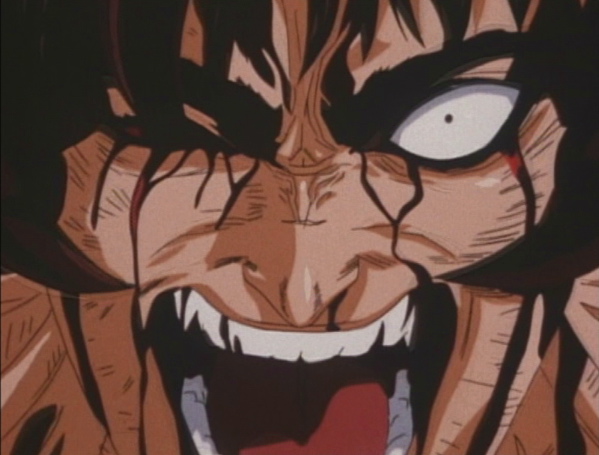
The final stretch of Berserk is excellent … but then there is the matter of the ending.
It can not be denied that the characters and situations in Berserk are excellently realised; I have got a fair bit of mileage from regaling my friends with stories of the exploits of the series, so rich and colourful that people react in all the right spots (“This guy’s a bastard!”). This is the sort of anime you could steal and adapt it to tell by the firelight at a hunting lodge or smithy deep in the mountains.
From the battlefield. where Guts and Caska reach an understanding, Berserk bleeds right into court drama. Moreso than on the battlefield, the nature of Griffith can be understood in this context. Griffith is not a nice person; his dream, as Guts realises, takes precedence over all else. One can understand Griffith’s charisma, but the audience can see his determined eyes: they are huge and cold; piercing, like a hawk.
Guts, on the other hand, is not as cold as one might think: some of the best moments in this series are the conversations between Guts and Caska. Here it is revealed how well he knows his fellow band members, and that he genuinely cares for them. Guts may be gruff, and uncomfortable in fancy regalia, but he is very human indeed.
So, to the last two episodes: they deliver exactly what is promised in the first. What we get is Supernatural Berserk, which I did not really find enjoyable. Most of the program had nice moments, but the conclusion is completely bleak; it is from these two episodes that Berserk receives its reputation.
The change of gear is not the major issue, however: Berserk ends on the biggest cliffhange ever! Almost never has there been a louder shout from the director of “buy the manga!” than Berserk episode 25. This is very edgy indeed.
While the final episodes may produce nail-biting moments of tension, Berserk was wonderful at what it aimed to be: an account of Guts’ life in the Band of the Hawk.
Argentosoma – episodes 15 to 25 and episode EX
April 30, 2005 on 11:39 pm | In Argentosoma | Comments Off on Argentosoma – episodes 15 to 25 and episode EXSequel to this article from two months back.

Despite its clunky start, Argentosoma geared up in its second half to present a dynamic blend of intrigue, twists and drama.
Takuto realises that he is not exactly the nicest person to talk to, through the assistance of Hattie. Watching Hattie lash out and “not shut up” really opens his eyes; she also makes Takuto realise that she is not Maki, and he cannot treat her as such. Their resemblance and shared seiyuu are little more than anime-flavoured coincidence.
The questions of “what are we fighting for and against?” are answered more than satisfactorily, with at least one of the revelations being a true “anime shiver” moment – one where you can feel the impact in your spine (I have had this feeling only two other times that I can remember: once in Nadia, and the other in City Hunter 2). For this reason, Argentosoma graduated to something very special for me.
Adding another layer of excellence is the fact that after the conclusion there is an epilogue episode, set six years later. There is not only the relief of seeing a matured Hattie (she ends up fine, folks – her voice changes!), but also of seeing the growth of the rest of the cast (and Sue’s inexplicable makeover).
This is not the kicker; the kicker is that by the end I had come to love Mr. X. In grand anime tradition, he managed to provoke a strong reaction with his final appearance.
After this is the budgeted but unbroadcast episode EX. It is chronologically implacable, occurring before key events in the series but relying on the viewer to have knowledge of revelations. This episode deals with giving Sue a depth of history and is quite good, if unessential. It is definitely odd to watch after the series proper, but is worthwhile for the hilarious Takehito Koyasu/Horie Yui omake ED.
If anything, Argentosoma exceeds expectations. Patience pays off, and the ED makes divine sense after all!
Emma – episode 3
April 27, 2005 on 10:35 pm | In Emma | Comments Off on Emma – episode 3“Confession”


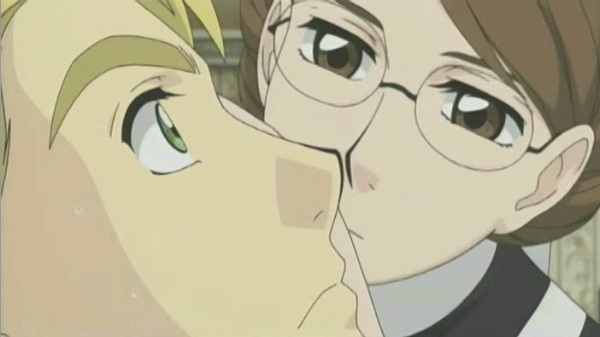
Warning: Meeting Emma may impair your social judgment!
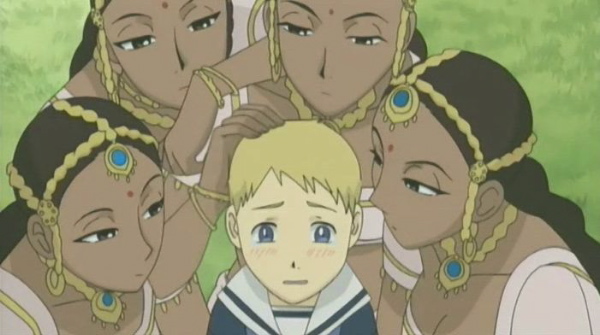
In this episode, William’s friend Hakim comes to visit from India. Hakim takes William on an elephant ride through the streets of London, but William gets sick and has to stop off at Emma’s house. Emma meets Hakim, who is instantly taken by her; Hakim consults Emma as to her feelings for William, and then confesses his own feelings.
This appears to be the first episode of Emma to actually go for the laughs, with Hakim’s tight-lipped harem following him everywhere; William’s younger brother is particularly distressed by all of the foreign goings on. William himself is consistently dazed by what’s happening around him but is pleased because “I got to see Emma”. Nothing goes wrong in this episode, besides the obvious issue of another person vying for Emma’s affections (please, people, she doesn’t want your gifts!).
On the Emma front (as there is remarkably little Emma in Emma): Mrs. Stownar seems a bit mean to Emma, but I suppose that’s what high class people do. Also, Emma does have a moment of reflection in her room, but it is mercifully not while she’s combing her hair and looking into the mirror; the consideration scenes in this episode, both her own and William’s, are well done.
All in all, a fine episode that even included some nice CG.
Next time: Hakim, Eleanor, Emma and William Battle Royale!
Vandread
April 27, 2005 on 10:04 pm | In Vandread | Comments Off on VandreadIn the future, men and women have had a falling out … to the point where they have split planets and are perpetually at war. The men live on Tarak and the women on Mejale. Tarak babies are produced in factories, and Mejale babies are produced internally by some scientific process with special words that probably make sense to someone.
This is not their story, but it is the context from which this story springs.
Vandread opens with the Tarak forces launching a new space station filled with new ships known as vanguards. Only moments after lift-off, they are set upon by pirates – female pirates! Realising that the old part of their station has been lost, the Tarak jettison it, leaving the pirates and three unfortunate male stow-aways on board. The Tarak blast the old station with a “Paksis” beam, which does not destroy it but rather fuses it with the pirates’ ship. The Paksis also changes several key areas of the ship, including the engine and all of the mech units on board.
Escaping in their new ship, the Nirvana, the pirates keep the men prisoner but realise in time that the unique services offered by the trio are necessary for smooth running: Hibiki on vanguard, Bart as the helmsman, and Duero as doctor (women of the future can make children by themselves, but cannot perform medical checks without machines). They also realise that the new vanguards can combine with the women’s dreads to form ultra powerful vandreads.
This is useful, because they also have the matter of attacks from unknown alien forces to contend with!
The story of Vandread is developed fairly well, with this thirteen episode series tightly directed and featuring a cute Christmas episode (beware SF anime with nice Christmas episodes!). The final three are quite dramatic and conclude fairly well, then do that classic “lead-in to a sequel” that everyone loves so much (Second Stage followed soon thereafter). The only point of contention is that the final dramatic push is set into motion on a fundamentally flawed premise that involves wild character irrationalities. Still, this amounts to less than half an episode and can be overlooked; the majority of Vandread is fun with a splash of intrigue simmering in the background.
Much is made of the fact that this is a war of the sexes; while there is tension on the ship, it is not to the extent that one might expect. The men and women featured in Vandread are all atypical of the society they live in: the women are pirates, and the men are all outcasts in Tarak. Standard Mejale and Tarak would kill each other on sight; naturally, this would not make for a great series.
Interestingly, in a society that would by default suggest all of its members are homosexual, there are only a few clearly defined lesbians. Men on Tarak have conversations along the lines of “When this is all over, what say we make a baby together?” “A baby with you? That sounds like a great idea!”.
Despite the large cast of women, there are clearly defined important characters: the core Dread team of Jura, Dita and Meia; pirate captain and sole old woman Magno (more commonly referred to as “Old Hag”); and Hibiki. Duero and Bart have important roles as well, but they get significantly less screen time, as does ship mascot Pyoro.
Dita is the old-fashioned enthusiastic, dedicated-to-one-guy girl who cheers the ship with her endless vitality. She also has feelings and is not completely oblivious to those of Hibiki. Meia has her own past and Jura is an excellent comedy foil as well as sometime lesbian.
Hibiki is plagued by class-consciousness, an inferiority complex and an impatience when it comes to women. Yet somehow he manages to have a heart of gold and a stomach of cast iron. He is a character that has self doubts without being a whiney crybaby.
The OP and ED are perhaps too dramatic for their own good, with the ED sounding like the equivalent of an aural drowning. This is a Gonzo program, so it is packed with CG. The amazing thing is that the CG is actually quite good, as TV of this 2000 period really shouldn’t have had much CG thrown into it. The action scenes look pretty damned nice; not much TV seems to do the CG kick lately (that I have seen, anyway), and in many cases it seems pretty … lame … but Vandread pulls it off elegantly due to its lack of attempts to blend: every scene is either all 2D or all CG. The characters are really quite attractive, and there’s quite a bit of bounce going on. This is fan service at the high class level it was before the modern saturation point.
Vandread is the right sort of anime, created at a time before this sort of anime went bad. The level of fan service is just right, the characters are fun and the CG is surprisingly not bad at all. Add in a little bit of drama, and some excellenté discussions of the rights of orangutans in space and you’ve got a nice series to watch.
Emma – episode 2
April 24, 2005 on 11:05 pm | In Emma | Comments Off on Emma – episode 2“Two worlds”


It sounds obvious, but one should not watch an episode of Emma with an hour between halves; it leaves one with misgivings and feelings of terror. This is because, despite William’s affability, he is unable to understand his society. In some ways he is ahead of his time, and the problem with being ahead of your time is that it is inappropriate in regard to social mores.
In this episode, it is revealed that William actually does have a job, working for his father’s company; he just never attends, the cad. This is not his father’s issue; the problem is that William has not attended any balls in the latest Victorian social season. So William acquiesces and attends a ball, where he meets Eleanor. Eleanor is a blushing young girl who has one thing over Emma: she comes from the nobility, which the gentry aim to marry into.
Eleanor is a nice character; she is not scheming or vindictive. As a rival for William’s affections, she is unobjectional, if ultimately (see the title) unsuccessful.
The problem with this episode is simple: parasol shopping. Never ask a woman what a good present for a woman is, and then buy the present in front of her, and then not give her the present in question. That’s suicide, man!
Naturally, William intends this parasol for Emma. Yet, as a maid, Emma can’t possily accept so many, and so expensive, gifts.
“Really, it’s nothing,” says William.
“It is for me,” says Emma.
Somehow, by the end of the episode everything is resolved so neatly that one can’t help but forgive the clueless young rogue and his painful social stumblings.
Other highlights of the episode include the introduction of William’s siblings, attractive and nice people. The only problem with Emma is that scenes featuring Emma gazing into her mirror and combing her hair threaten to be rife.
Next episode: exotic foreigners, from foreign lands exotic!
Powered by WordPress with Pool theme design by Borja Fernandez.
Entries and comments feeds.
Valid XHTML and CSS. ^Top^